✦ A substantive research chapter
Start with the red mark
A red mark in the corner of a painting can look like a signature. Another red mark beside it can look like a second signature. A third can seem to be part of the composition. Those readings are all plausible, and none follows from the color alone. The painter, a later owner, and an institution can leave impressions on the same object. The first task is to work out which action a particular mark records.
Chinese seals bring writing, carving, ownership, and composition into the same small space. They belong in this collection because heraldic research frequently encounters seals and asks similar questions about identity. The comparison becomes useful when we keep the different mechanisms visible. A seal impression can identify someone without displaying arms, and a painting can accumulate seals without becoming a composite coat of arms.
The Metropolitan Museum’s exhibition on Xie Zhiliu treats seal carving as part of a painter’s working and intellectual life. It also distinguishes artists’ marks from collectors’ additions.1 That distinction changes how we read an object. Instead of asking only whose picture this is, we can ask who made it, who handled it later, and which of those people wanted their association with it to remain visible.
The matrix and its impression
The matrix is the object that carries the printing surface. The impression is the mark it leaves. They are related witnesses, but they need separate descriptions. A damaged corner on a matrix might help identify its impressions; a beautiful carved handle might tell us nothing about the letters that were printed beneath it.
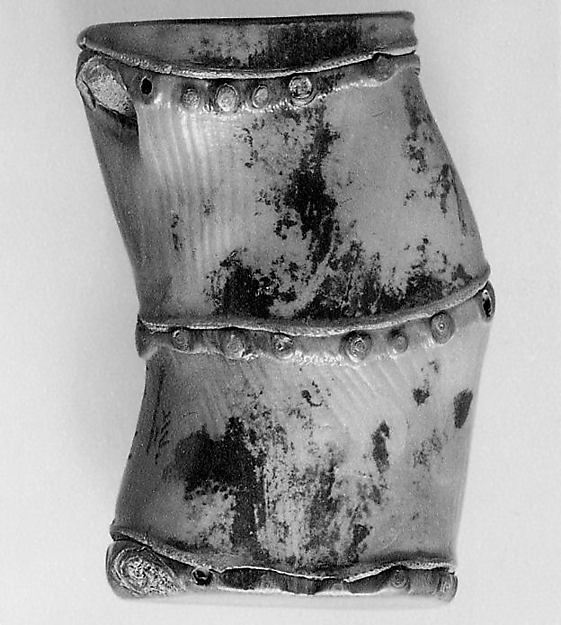
This bamboo seal makes the distinction unusually clear. Its catalogue assigns a period, material, and accession number. The photograph lets us inspect the body’s carving. It does not let us transcribe the printing face.2 A caption that supplied a supposed inscription from this photograph would be adding information that the photograph cannot support.
The Qianlong period is also a date designation. It does not mean that the Qianlong emperor owned this particular seal. An imperial reign can organize a museum’s chronology without supplying the provenance of every object assigned to it. The period, owner, carver, and eventual donor are four different entries in an object’s history.
That separation matters when a matrix has survived without its documents. We can describe what is present and search for corresponding impressions. We cannot manufacture the missing connection by selecting a famous name from the dating field.
Cut the letters or cut around them
The relationship between carving and impression supplies a second problem. The Met’s exhibition explains that incised lettering yields white writing within a red field, whereas lettering left in relief produces red writing.1 The maker changes what remains on the printing surface, and the resulting impression reverses our experience of the cut object.
This is a technical distinction before it is an interpretive one. Two impressions can preserve similar wording while distributing red and white differently. A catalogue that records only the text loses information about how the seal was made. A visual comparison that records only the overall square loses information about the script.
Imagine a teaching pair bearing the same invented studio name. One has fine white strokes enclosed by a dense red field. The other has heavier red strokes with white space around them. Their wording alone would not establish that one is a copy of the other. Their shared outline would not establish that they came from the same matrix. A defensible comparison would record lettering, spacing, border, dimensions, and observable defects.
We should also distinguish legibility from identification. Recognizing a character is one operation; establishing whose seal it is requires another. An abbreviated name, literary name, or studio designation needs contextual evidence. The appearance of familiar writing does not turn an uncertain attribution into a secure one.
The artist’s mark has a place in the picture
An impression occupies physical space. Its location can interact with a painting’s edges, inscriptions, and open areas. A mark associated with the artist may therefore do two jobs: identify an artistic association and contribute to the finished arrangement. These jobs can coexist without the seal becoming a depicted object inside the painted scene.
That is a useful complication for anyone trained to treat identity marks as labels attached after the real image is finished. The label can participate in the image. A small red square can create a visual emphasis that a purely textual transcription will not preserve. Conversely, an attractive arrangement cannot establish who placed the square there.
A study of the composition should record the position of an impression as well as its reading. “Lower left, close to the inscription” gives another researcher something to examine. “Artist’s signature” compresses location, authorship, and function into a conclusion that may require three separate arguments.
For a comparative heraldic reader, this is a warning about method rather than an exotic exception. We already distinguish an armorial seal’s inscription from its shield and the shield from the surrounding design. Chinese material asks us to make similarly careful distinctions while allowing writing itself to carry much of the visual identity.
A later owner can become visible
The Met’s Immortal Holding a Peach supplies a concrete chronological problem. The museum dates the silk tapestry to the sixteenth century and describes seals on both sides connecting it to the Qianlong emperor’s study.3 The older textile and the later collecting layer should not be collapsed into a single moment.
An object can retain its original subject while acquiring new evidence of possession. The added marks tell us something about its subsequent life. They do not retroactively make its original production an act of that later collector. This is the same temporal discipline needed when a medieval manuscript receives an early modern bookplate.
Now consider what a photograph can conceal. A front view might show the woven subject while omitting a mark on the reverse. A cropped image might remove the edge where a collector left an impression. An attractive reproduction is therefore not automatically a complete witness to the object’s collecting history.
There is a further distinction between a collecting claim and its verification. An impression can assert an association. To evaluate that association, researchers may need comparisons with other impressions, the physical history of the work, and documentary provenance. The presence of a famous name supplies an important question; it does not remove the need to ask it.
Several seals make a history, not a pedigree chart
The InscrChArt record for The Pleasures of Fishes, Met 47.18.10, lists named collectors including Qianlong, Wu Yuanhui, and Gu Linshi, alongside unidentified marks.4 Such an inventory is a starting point for a history of the work. It should not be converted automatically into a complete chain of uninterrupted ownership.
A succession of identified people does not establish every transfer between them. Nor does the arrangement of impressions necessarily display chronological order. We need dates, documentation, and physical relationships before deciding how marks connect. Some entries may remain unidentified even after much of the object’s history becomes clearer.
The unidentified category is especially useful. It preserves a visible witness without forcing it into a story. A research notebook should be able to say “mark present; owner unresolved” and then keep working. Deleting the mark from the account would conceal evidence. Assigning it to the nearest plausible collector would conceal uncertainty.
The difference from a heraldic pedigree is substantial. A collecting sequence concerns an object moving among people. A hereditary armorial sequence concerns the transmission of an entitlement or design within a defined practice. Both involve names and time; the relationship that binds those names is different.
Carry the comparison back to heraldry
Choose one armorial seal from the object studies and one Chinese seal or seal-bearing work from this chapter. Record the matrix or impression, the inscription, the image, the attributed user, and the physical support. Leave fields empty when the evidence does not supply an answer.
Then explain how each mark does its work. Does the user’s identity depend principally on writing, a shield, a combination, or a documented convention? Is the surviving witness an object made for repeated printing, a single surviving impression, or a later photograph? Can the mark be associated with an act, or only with a name?
A good comparison will produce some common questions and some different answers. That is its value. These materials enlarge our understanding of visual identity because they give us another account of how writing, objects, and possession can become visible together.
A Han seal can identify an office
The Met dates silver seal 1994.605.14 to the first or second century and reads its inscription as “Seal of Tiannan General.” The matrix has a turtle-shaped knob and a square-format printing face. The museum places its seal script within the Qin and Han standardization of that archaic writing style.5 This object brings an office designation into the comparison, alongside the later artistic and collecting uses already discussed.
The inscription answers a different identity question from a painter’s studio name. An office can persist through changes of holder. A seal naming that office need not preserve the name of the person using it at a particular moment. To connect an impression with an individual, we would need its document, date or another identifying witness. The carved title alone cannot supply the whole administrative biography.
The knob and face also belong to different encounters with the object. A handler can grasp or inspect the three-dimensional matrix; the recipient of a document sees an impression from its working face. The turtle does not become a printed animal merely because it sits on the matrix. We should record its material position before comparing it with an animal depicted within an armorial seal’s impression.
This distinction is useful in photographs. A view selected to display the turtle may show very little of the inscription. Another view can make the inscription legible while hiding the sculptural form. Neither is intrinsically the “real” seal image. They answer different questions about one object. A serious reference should identify the photographed surface and supply the museum’s reading separately from what the photograph itself lets us inspect.
A private seal can enter an imperial collection
The National Palace Museum catalogues a Han bronze private seal inscribed with Guo Sa’s name. It is the larger surviving member of a nesting pair; the smaller seal is missing. The catalogue records its later placement within Qianlong’s organized collection of earlier seals.6 The same matrix therefore has an ancient identifying function and a much later collecting history.
The missing member matters materially. A nesting structure organizes more than one printing object within one combined form. If only the outer member survives, its present appearance may not show how the complete pair originally operated. We can describe the surviving inscription without pretending the loss supplies no uncertainty. Nor should we invent the smaller seal’s wording by assuming it repeated the larger one.
Imperial collection changes the object’s classification and setting while preserving its earlier association. Guo Sa’s private seal does not become Qianlong’s personal seal because the emperor collected it. The owner of the matrix, the person named on its face and the authority under which a later impression was made can be different. That is a particularly important distinction when museum records combine ancient objects with an early modern imperial provenance.
The catalogue’s arrangement also gives us a historical research question. How did a collector distinguish official from private seals, and what kinds of order were imposed on the surviving material? An inventory is an intellectual object as well as a list. Studying its categories can reveal what a later collection made visible and what it placed in the background. The earlier seal and the later system for storing it belong in the same history without becoming the same act.
Qianlong’s oval face and dated side inscription
Jade seal 故玉005673 has an oval incised face bearing Qianlong’s reign name. The museum records a separate poem on the body dated to 1753, and a body shaped like an irregular stone.7 The object combines a printing inscription, another textual surface and a sculptural treatment. “Inscribed jade seal” is accurate but much too compressed to explain the arrangement.
Begin with the printing face. Its oval outline provides a different constraint from the square examples. Characters must occupy the available area, and the negative space becomes part of their organization. A transcription supplies wording; an image or diagram supplies the layout. To compare matrices accurately, retain both. Matching text on an oval and a square face would not establish a shared printing object.
Now move to the side. The poem’s date belongs to a documented inscription on that surface. It supplies evidence about the seal’s history, but it should not be treated as the printing face’s text. A catalogue needs separate inscription fields if it is to preserve that distinction. Otherwise a search result can imply that the seal printed an entire poem when the poem was actually carried on its body.
The stone-shaped body gives another example of the difference between a functional face and an object’s larger form. A seal can have a carefully organized inscription below an irregular sculptural outline. The outline may affect handling, presentation and appreciation while the face carries the printed identity. The printing function does not make the rest of the object irrelevant; it makes the relationship between the parts worth describing.
An imperial seal can carry an auspicious declaration
Another National Palace Museum seal bears the inscription 五福五代堂古稀天子寶. The museum relates its language to Qianlong’s age beyond seventy and the unusual distinction of five generations living together, and identifies impressions on collected works. Its printing face is relief-lettered.8 We can preserve the original wording while paraphrasing the institutional interpretation, rather than substituting a confidently invented short English name.
The seal does more than supply a reign name. It expresses a particular account of the emperor’s circumstances and standing. The text can therefore identify a relationship with a collector while communicating something about how that collector represented himself. Name-bearing and idea-bearing marks need not form mutually exclusive classes. A seal can perform both operations within one composition.
Its interpretation also introduces chronology internal to a reign. A reign-period date range organizes objects broadly; an inscription invoking advanced age and several generations belongs to a more particular self-presentation. We should let that evidence refine the question without using it to assign an exact manufacturing day. The object record gives a basis for interpretation, not permission to resolve every missing date.
The association with impressions on collected works provides a route from matrix to use. It is stronger than a general assertion that emperors stamped pictures because it identifies a named seal and a recorded occurrence. A next-stage study would compare the impression’s lettering and dimensions with the face, then investigate the support, position and documentation of that occurrence. Similarity and historical attribution can be assessed together.
Red and white describe a printing relationship
The Chinese terms zhuwen (朱文) and baiwen (白文) distinguish red-letter and white-letter impressions in this context. The relief-lettered imperial seal and the incised Guo Sa seal give us dated objects with which to make the distinction concrete.86 They are not a Chinese version of the heraldic rule of tincture. They describe the relation between carved surface, pigment and blank areas of the impression.
For an invented exercise, imagine an incised name cut below the printing surface. Pigment reaches the surrounding face while the recessed strokes remain blank in the impression. In a relief-lettered version, the retained raised strokes carry pigment and the cut-away surroundings do not. The mark’s apparent red-white distribution follows from what is left on the working surface. That mechanism should be understood before the terms are memorized.
The face also needs to compensate for reversal in printing. A diagram copied directly from an impression is not automatically a correct diagram of the matrix. Compare mirrored layouts deliberately and label the view. The principle is shared with other printing technologies, including armorial seal matrices, without requiring identical scripts or historical functions.
Build an inscription record that can be checked
A useful record separates original characters, reading, translation, surface and proposed referent. Keep a museum’s transliteration distinct from an editor’s translation. If a script or character is unresolved, record the uncertainty at that point rather than replacing the entire inscription with a vague label. If only one surface has been photographed, identify that limitation in the image description.
| Field | Example of the distinction it preserves |
|---|---|
| Printing face | What the matrix could impress |
| Side inscription | Text carried on the object but not necessarily printed |
| Museum reading | The institution’s transcription or identification |
| English interpretation | An attributed explanation of what the wording means |
| Impression on another work | Evidence of a particular use or association |
For a research exercise, compare the Han office seal, the private Guo Sa matrix and Qianlong’s oval seal. Ask which names or titles are printed, which other texts remain on the body, and what later collecting information survives. The resulting comparison will explain several mechanisms of identity rather than treating every carved object as a generic signature.
What survives when the context is lost?
The matrix can preserve a printing face, material and other inscriptions. Its wording may identify a person or office, but a particular act of use needs an impression or document. A later collection record can explain custody without changing the original inscription’s referent. Keeping these distinctions allows an incomplete object history to remain useful while preventing the missing context from being filled with a famous name.
A documentary workshop
Suppose a catalogue dates a painting to the seventeenth century, identifies an eighteenth-century collector’s impression, and records an unidentified red mark beside it. A dealer’s caption calls the whole work “the collector’s painting” and gives the unidentified mark the artist’s name. These are invented teaching records.
Prepare a four-column inventory: visible feature, proposed identification, supporting witness, and unresolved question. Keep the painting’s date separate from the impression’s proposed date. Then write a caption that a reader could check without access to your private assumptions.
Discuss the evidence
The collector’s association can be reported with attribution to the catalogue. The unidentified mark should remain unidentified unless a new witness supports a reading. The painting’s production date does not date every impression upon it. A responsible caption distinguishes the older work from its later collecting evidence and identifies the photographed surfaces. The dealer’s claim is another witness to evaluate, not a substitute for the catalogue or object.
Footnotes
-
The Metropolitan Museum of Art, Mastering the Art of Chinese Painting: Xie Zhiliu, 2010 exhibition, section “The Art of Seal Carving.” ↩ ↩2
-
The Met, Seal, 58.64.16. ↩
-
The Met, Immortal Holding a Peach. ↩
-
Miami University Libraries, InscrChArt, The Pleasures of Fishes. Consulted through the indexed catalogue record; this chapter does not claim a fresh examination of the complete painting. ↩
-
The Metropolitan Museum of Art, 1994.605.14, Seal with Knob in the Shape of a Turtle. Consulted 11 October 2026. Original English editorial synthesis; consult the linked record for close reading. ↩
-
National Palace Museum, Taipei, 故銅001257N000000000, 「郭颯印信」銅印. Consulted 11 October 2026. Original English editorial synthesis; consult the linked record for close reading. ↩ ↩2
-
National Palace Museum, Taipei, 故玉005673N000000000, 「乾隆」玉璽. Consulted 11 October 2026. Original English editorial synthesis; consult the linked record for close reading. ↩
-
National Palace Museum, Taipei, 故雜001377N000000000, 玉「五福五代堂古稀天子寶」璽. Consulted 11 October 2026. Original English editorial synthesis; consult the linked record for close reading. ↩ ↩2
These essays are original English-language syntheses with visible archival and institutional citations. They have not been independently reviewed by regional specialists. Readers should check consequential assertions against the linked source language and current law.