✦ A substantive research chapter
The tiger’s rank depends on the dynasty
The Met’s eighteenth-century Chinese tiger badge belongs to the Qing period. Its account explains that a tiger denoted the third military rank under the Ming and the fourth under the Qing.1 The same recognizable animal therefore supplies a different status reading in different institutional contexts. Identifying the creature is the beginning of interpretation; identifying the applicable convention completes another necessary step.
The organizing model is a mapping between a visual device and a classified office or rank. The mapping is maintained within an institution and can change over time. A badge makes the classification visible on clothing. Its meaning depends on an audience that knows the system, rather than on an inherent numerical quality of the animal.
This is an excellent comparison for heraldry because it isolates a particular task: showing status through an emblem. The badge does not need to be treated as inherited family arms to be historically sophisticated. We should follow what the institution asks the device to communicate and how the garment makes that information available to observers.
Look at the Qing textile
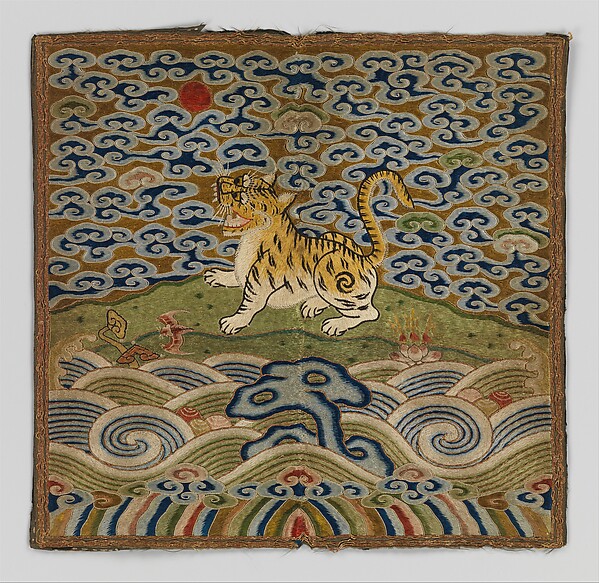
The tiger occupies the central area while clouds and waves organize the surrounding space. The photograph also shows the textile’s edges and wear. The complete composition is more than a silhouette of the rank animal. A material study should retain the ground, borders, technique, condition, and relation to clothing alongside the creature’s identifying role.
The catalogue specifies silk and metallic thread.1 Those materials allow texture and reflected light to participate in the surface. A flat digital reproduction cannot preserve all those effects. Color differences in the photograph may also depend on lighting and the condition of the textile. The written description supplies the institution’s classification; a technical study would need direct examination or conservation evidence for the material history.
A detached badge loses the original wearer and garment unless those relationships are documented. Its conventional rank association can still be studied. Identifying the individual who wore it requires another source. A badge can provide a reliable status category within a dated system without supplying a person’s name.
A bear can look unfamiliar and remain a bear
The Met’s bear badge, dated to the late seventeenth or early eighteenth century, is identified with the fifth military rank. The catalogue explains that the conventional bear can have a mane, extended tail, and exaggerated paws, unlike a naturalistic animal.2 Zoological resemblance is therefore an imperfect method for identifying the device.
The comparison makes a general iconographic mechanism visible. A convention selects features that an informed audience learns to recognize. Some features can be emphasized while others are reshaped or omitted. The result can remain stable within the emblematic system even where a modern outsider initially names the wrong animal. Studying the convention improves identification more effectively than correcting the textile to look like a wildlife photograph.
The same issue occurs in European heraldic beasts, but the comparison concerns a problem rather than a shared rulebook. Each system has its own conventional figures and associations. A researcher should preserve the catalogue’s identification, record visible features, and investigate the supporting comparisons. If an identification remains contested, keep the alternative readings and their reasons in the apparatus.
Joseon creates its own sequence
The Met’s Korean account places adoption of the hyungbae rank-insignia system in the mid-fifteenth century. Initially restricted to higher officials, it later extended across nine ranks. The account identifies a standardization in 1871 using cranes for civil officials and tigers for military officials, and suspension of the system in 1899.3 This is a dated Korean institutional sequence with changes in participation and classification.
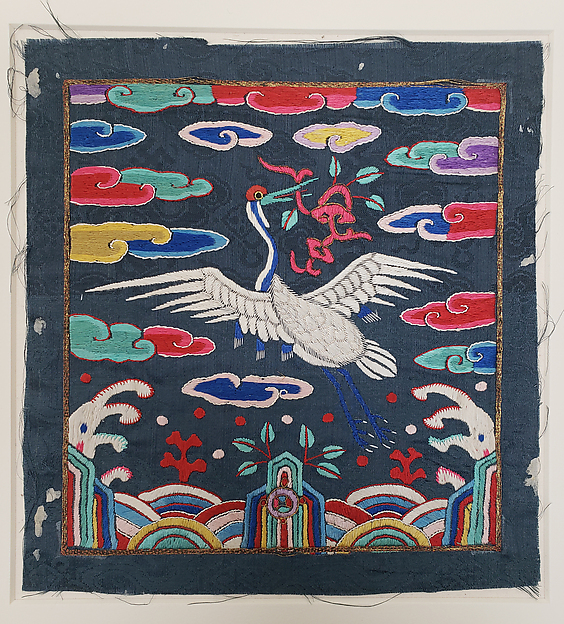
The photographed object shows a single crane amid a larger arrangement of clouds and other forms. The museum’s broader explanatory text discusses several examples, including double-crane forms.3 Do not transfer every motif mentioned in the group explanation to this particular accession. The object identifier keeps a general account and an individual photograph from merging into a textile that never existed.
The change in eligible ranks also changes the system’s social reach. A visual convention used only by a smaller upper group communicates within a narrower institutional field. Extending it across more ranks increases the distinctions it needs to make. A study of the reform should therefore examine participation and administrative classification as well as changes in motifs.
Garments put classification into an encounter
A rank badge is displayed on clothing where an audience can see it during social and official encounters. Position and orientation matter because the wearer’s body supplies the support. A detached square preserved in a museum makes the design available for close examination, while a historical image of the complete garment can show how it was encountered in use.
Model the difference with an invented robe bearing a status panel. The panel’s category might be legible to someone facing the wearer, while the robe’s cut and other components communicate further status. The complete identifying system includes the panel and garment together. Isolating the square can help compare designs; it cannot explain every aspect of the clothing hierarchy.
Attachment also creates material questions. Was the panel made for this garment, transferred, repaired, or replaced? A surviving badge’s date may differ from that of a later support. Wear can obscure a motif; conservation can alter the present appearance. These are specific object questions to investigate through seams, records, and technical evidence, rather than conclusions to infer merely from an old-looking surface.
One animal is not one universal rank
| Context documented here | Device | Institutional reading in the consulted account |
|---|---|---|
| Ming military classification | Tiger | Third rank |
| Qing military classification | Tiger | Fourth rank |
| Qing military badge comparison | Bear | Fifth rank |
| Joseon after the 1871 standardization | Crane / tiger | Civil / military distinction, with further rank forms |
The table is deliberately bounded by its sources. It supplies documented comparisons rather than a complete chart of every Chinese and Korean rank over several centuries. To expand it, add dated regulations and artifacts with explicit identifications. A comprehensive table has to preserve change rather than selecting one convenient period and applying it everywhere.
The Japanese kamon chapter supplies a different comparison centered on family and collective identifying designs. The Catholic chapter shows office-related insignia around personal arms. Together, the cases let us separate identity and rank while investigating how one composition can sometimes communicate both.
Nine ranks form a dated code
Williams College Museum of Art’s study provides the following late-Qing mapping. The first rank is the highest; the seventh military entry includes a change after 1759.4 This is a table for the specified system and period. It should travel with those qualifications when used to identify an object.
| Rank | Civil figure | Military figure |
|---|---|---|
| 1 | Crane | Qilin |
| 2 | Golden pheasant | Lion |
| 3 | Peacock | Leopard |
| 4 | Wild goose | Tiger |
| 5 | Silver pheasant | Bear |
| 6 | Egret | Panther |
| 7 | Mandarin duck | Rhinoceros after 1759 |
| 8 | Quail | Rhinoceros |
| 9 | Paradise flycatcher | Horse, the museum study’s term |
The duplicated rhinoceros demonstrates a limit to identification from the principal animal alone. If a system assigns the same broad creature to more than one rank, species recognition cannot decide between them. Additional details, dating and contextual records become necessary. A tidy animal-to-number lookup works only where the mapping is actually one-to-one.
The term qilin also needs to remain visible. It names a conventional creature, rather than a species that a natural-history guide will resolve. Translating every unfamiliar figure as “unicorn” could make comparisons easier superficially while introducing features from another visual system. Describe the figure and the source’s name together. The same applies to historically variable English animal labels, whose precision should not be exaggerated merely because they look familiar.
Rank is one classification within a larger administrative system. A first-rank civil badge and a first-rank military badge share a number while marking different categories of office. We cannot turn the table into one linear sequence of eighteen ranks. The classification has at least two dimensions: category and rank within that category. This is a useful model for understanding insignia well beyond East Asia.
Two cranes can share a rank and differ as textiles
The Met’s Kangxi-period badge 30.75.830 represents the highest civil rank through a crane. It is a silk tapestry, or kesi, with some metallic-thread details, and the museum identifies its sun as a Qing innovation. Badge 36.65.10, dated to the late seventeenth or early eighteenth century, uses silk and metallic-thread embroidery on satin for the same civil-rank figure.56
The comparison isolates a technical variable while holding the broad classification constant. In tapestry the design is made through weaving. In embroidery stitches are worked on a support already made. The same identifying bird can therefore emerge through different sequences of manufacture. A catalogue that records only “crane badge, rank one” answers the administrative question while leaving the object’s making largely unexplained.
Different techniques also produce different questions for examination. For tapestry, investigate how colored woven areas join and how small contours are formed. For embroidery, investigate stitch direction, density and the relationship between the added thread and the satin ground. Metallic thread can accent edges or details, but its present brightness depends on condition and lighting. These are questions to take to the textile, conservation report or sufficiently detailed image, rather than conclusions to derive from rank alone.
The crane’s position within its surrounding design matters too. A sun, clouds, water and borders organize the space in which the classification figure appears. The principal bird can perform the identifying work while the larger composition gives that identification a courtly or auspicious setting. “Decorative background” is sometimes too dismissive a category. The background can affect how the viewer encounters the figure without becoming another rank animal.
The dated introduction of the sun shows that visual change can occur outside the species-to-rank mapping. A researcher comparing two badges should ask separately whether the principal classification changed and whether its surrounding grammar changed. Otherwise every compositional difference becomes an alleged promotion, or every continuity of rank becomes a claim that the entire design stayed fixed.
A garment turns the code into public recognition
A detached textile presents the classification as a square object. Worn clothing presents it at a particular height, orientation and distance from other people. The badge’s material arrangement belongs to that encounter. A courtly rank system needs viewers to recognize the category within the circumstances in which officials appear; an archive inventory can afford far more time for identification than an encounter in motion.
Williams’s study connects civil and military orientations with officials’ respective places at court, and describes Qing provisions permitting wives and children to wear a husband’s or father’s insignia.4 These facts complicate the assumption that every badge directly identifies its wearer’s own appointment. Institutional affiliation can be communicated through a family relationship as well as through officeholding.
Suppose an undated portrait shows a person wearing a crane badge. Even if the bird is identified securely, the portrait needs its own historical context before we assign the sitter an office. Was the applicable convention personal officeholding, a permitted family association or another documented arrangement? The material cannot decide that social relationship by itself. The portrait’s inscription, provenance and the relevant clothing rules may supply the missing evidence.
This is a useful comparison with Catholic ecclesiastical heraldry. External insignia can communicate an office without identifying the person’s family arms. In both settings, status and identity can appear together while remaining different information. The comparison does not require the systems to have identical rules; it clarifies the kind of question each visible component answers.
Chinese and Korean cranes require different tables
The Korean sequence already discussed here makes the comparative problem explicit. The Met records a Joseon system that changed over time and was standardized in 1871 around cranes for civil officials and tigers for military officials.3 A Chinese rank table cannot simply be carried across the border because its animal names seem familiar.
A code is a relationship maintained through institutions. Two systems can select the same creature while organizing its number, companions or position differently. To compare them, first identify the unit carrying the classification. Is the decisive feature the species alone, a pair of animals, a combination with a plant or another prescribed arrangement? That question directs attention to the complete Korean badge instead of treating its second crane as optional artistic balance.
It also helps distinguish cross-cultural borrowing from unchanged transmission. Adoption of an insignia system can create a local sequence of reforms, extensions and conventions. The borrowing is historically significant, but so are the later decisions. The strongest comparison follows both the transmitted structure and the locally established changes. “Derived from China” is a starting proposition to investigate, not a complete explanation of several centuries of Korean use.
Identify a detached badge in stages
Begin with the object’s support and technique, then record the visible figure without forcing an uncertain species. Compare the proposed identification with dated examples. Only after that should the relevant institutional mapping be applied. Finally, separate the conventional rank from any claim about an individual wearer. This sequence prevents one uncertain animal identification from becoming an entire invented biography.
A useful object note might say: “embroidered square textile; principal creature provisionally identified as a tiger; Qing date supplied by the catalogue; fourth military rank under the cited Qing convention; original wearer unresolved.” Each clause states a different evidential step. If the animal identification changes, the administrative interpretation can be revised without losing the material observations.
For a more difficult exercise, compare the embroidered crane, the tapestry crane and the Korean crane badge linked in this chapter. Record which observations concern manufacture, which identify an administrative category and which concern a cultural interpretation. A shared bird name cannot collapse those three kinds of statement into one.
Why does technique belong in the catalogue?
Technique does not necessarily alter the rank category, but it explains how the particular object was made and what its surface can reveal. The two Chinese crane badges permit comparison within a related classification while differing in manufacture. The Korean example requires its own dated convention. Keeping those variables separate makes the comparison explanatory instead of a search for the most similar outline.
Workshop: date the mapping before assigning the number
A constructed catalogue identifies an undated tiger badge as third military rank because it found a Ming chart. Later evidence places the textile in the Qing eighteenth century. Explain which part of the identification changes and which observation remains valid. Then state the evidence needed to identify a wearer.
Discuss the changed context
The observed tiger can remain the same while the applicable rank mapping changes. The consulted museum account places the tiger at fourth military rank under the Qing. The wearer’s identity still requires an independent record connecting a person with the garment or badge. Correcting the rank does not supply the missing name.
For a second exercise, compare the photographed Korean accession with its group-level catalogue explanation. List only the motifs visible on this accession, then record the broader system information separately. Explain how this prevents the single- and double-crane examples from being conflated.
Discuss object and system fields
The individual object field records the photographed single crane and visible surroundings. A separate system field records the account’s wider discussion of other badge forms and reforms. The accession identifies the particular textile; the system explanation supplies its historical context. Neither field should silently overwrite the other.
Graduate project: one reform in a clothing system
Choose a dated change in rank-insignia practice and assemble artifacts on both sides of it. Locate the relevant institutional or scholarly textual evidence and record the badge’s support, motif, attributed rank, and dating basis. Ask whether the change concerns the mapping, eligible wearers, physical form, or several of these together.
Include at least one complete-garment witness or historical representation of use. Explain what the detached badges preserve and what the fuller witness adds. A strong project can show how a classified institution becomes visible through clothing, while keeping the evidence for system, object, and individual wearer distinct.
Footnotes
-
The Met, Rank badge with tiger, 36.65.11, Qing object and Ming/Qing comparison. ↩ ↩2
-
The Met, Rank Badge with Bear, dating, rank, and conventional animal form. ↩
-
The Met, Civil-Official Hyungbae, 53.60.15, individual object and group-level explanation. Sources consulted 11 October 2026. The chapter’s English source language identifies the consulted catalogue text; it does not claim original Korean or Chinese regulatory-text examination. ↩ ↩2 ↩3
-
Williams College Museum of Art, Rank Badges at WCMA: An Exploration Through Digital Tools. Consulted 11 October 2026. Original English editorial synthesis; consult the linked record for close reading. ↩ ↩2
-
The Metropolitan Museum of Art, 30.75.830, Rank Badge. Consulted 11 October 2026. Original English editorial synthesis; consult the linked record for close reading. ↩
-
The Metropolitan Museum of Art, 36.65.10, Rank Badge with Crane. Consulted 11 October 2026. Original English editorial synthesis; consult the linked record for close reading. ↩
These essays are original English-language syntheses with visible archival and institutional citations. They have not been independently reviewed by regional specialists. Readers should check consequential assertions against the linked source language and current law.