✦ A substantive research chapter
Begin with something small
The British Museum holds a silver coin, 31 millimetres across, catalogued as Alchon and dated approximately to the fourth or fifth century. Beside the ruler’s portrait is a mark the catalogue identifies as an Alchon tamga. A Bactrian inscription accompanies the head; the other side carries damaged traces of a fire altar. We have a portrait, writing, a religious image, and a small identifying device on one object. Each component can contribute to an account of the coin, but each supplies a different kind of information.1
For a student of heraldry, the tamga is an invitation to look closely. An emblem can identify people and political relationships with very little drawing. Yet the mark does not arrive with a grant, a pedigree, or instructions explaining every use it ever had. We have to reconstruct the relationship between the sign and the people who used it. That is the central problem of this chapter: how does a recognizable mark become evidence of ownership, affiliation, or authority?
Tamga, also encountered as tamgha, names marks in several Eurasian historical and scholarly contexts. The sources here range from ancient coins and Sasanian objects to medieval Turkic archaeology, Mongolian horse branding, and contemporary Crimean Tatar art. This is a set of documented comparisons. Its chronological breadth lets us investigate changes of function; it does not establish that every object belongs to one continuous institution.
The attraction is that the drawings can be simple while the relationships are complicated. A mark might be easy to copy, yet hard for an outsider to understand. Knowing what it looks like gets us started. Knowing who recognizes it, what they think it identifies, and what happens when someone else uses it gets us much further.
Four parts of an identification system
Start with four components: a design, a support, a bearer or associated group, and an audience. The design is the configuration of strokes. The support is the thing carrying it: a coin, a stone, a seal, an animal, or an artwork. The associated person or group gives the design a social connection. The audience supplies the knowledge needed to interpret that connection. A catalogue photograph usually reveals the first two more directly than the last two.
Consider an explicitly invented example. Two households own animals that graze together. One uses an angular mark; the other uses a related mark with an extra stroke. If their neighbours know the distinction, the marks can help sort the animals. If we discover the two marks centuries later, we can record their resemblance immediately. To interpret the extra stroke as a relationship between households, however, we need evidence of the convention those neighbours understood. The drawing records a difference; the convention explains what the difference meant.
This gives us a useful way to compare tamgas with armorial designs. In either case, an emblem participates in a social system. The same image can be meaningful to an informed observer and almost empty to someone who knows only its geometry. Reconstructing the system means connecting visible differences to particular people, institutions, and occasions. A chart of shapes is therefore a finding aid. Its value increases when each shape has a dated object and a documented context behind it.
| Component | What to record | What it helps us investigate |
|---|---|---|
| Design | Strokes, junctions, orientation, damage, and uncertainty | Which features distinguish this occurrence? |
| Support | Material, object type, position, manufacture, and alteration | How was the mark made and encountered? |
| Association | Named person, issuing authority, community, or attribution | Whose identity or claim is being communicated? |
| Audience | Evidence about readers, users, conventions, and recognition | How could the mark do its job? |
The components can change independently. A design might survive while its users change. A group might retain an association while displaying the mark on a new material. An old mark might be adopted for a new collective purpose. Those possibilities make transmission a historical question rather than a result we can obtain by matching silhouettes.
Coins: a mark inside a political composition
The Alchon coin is especially useful because its catalogue gives us more than an isolated symbol. It records a findspot at Hadda Stupa 10, an excavation by Charles Masson in 1834, and a connection to a drawing in Masson’s manuscript. Those details provide a trail through which a researcher can investigate the museum’s identification and the object’s documented recovery. The mark belongs to an artifact with a history of collection as well as a history of manufacture.1
The distinction between those histories matters. The catalogue’s ancient date concerns the object. The nineteenth-century excavation concerns its recovery. The current description concerns scholarly interpretation. An argument about the coin’s original use must distinguish those stages and ask which observations support the interpretation at each one. A museum number identifies a collection record reliably; it does not itself identify the ancient person responsible for the design.
An earlier comparison is the British Museum’s copper coin 1987,0921.15, attributed to the Kushan ruler Vasudeva II and dated 270–300. Its catalogue describes a seated king on one side and the deity Ardochsho with a tamga on the other. It also records an overstrike on a coin of Hormizd I.2 That is a particularly valuable complication: the object can contain evidence of more than one act of issuing and marking.
We can now ask a more precise question than whether the coin “has a symbol.” Where does the mark sit within the composition? Which image or inscription accompanies it? Is its association established by the object itself, comparison with other coins, or the catalogue’s attribution? If a coin was overstruck, which visible features belong to which operation? Identifying the mark is one part of reconstructing the sequence that made the surviving object.
The two records also give us an elementary lesson in chronology. They document uses of marks described as tamgas in different settings. Placing the objects on a timeline makes the comparison manageable. Turning that timeline into a chain of direct descent would require additional evidence of transmission. Chronology can tell us which developments could precede others; it cannot provide the missing connection by itself.
Look at a photographed example
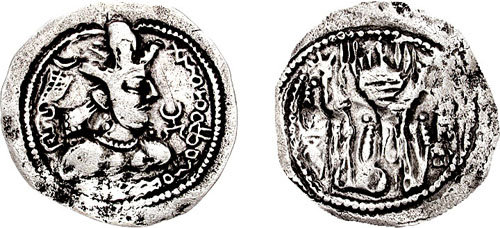

This photograph lets us keep the mark in its visual environment. First locate the portrait and the angular device beside it. Then examine the other face. Finally, compare what you can observe with the auction record, which identifies an anonymous Alchon issue and supplies a proposed mint attribution, references, and condition notes.3 The record is evidence of a modern numismatic identification; the photograph permits a limited examination of the photographed surfaces.
Keeping those two forms of evidence separate makes disagreements productive. If a verbal description and a photograph appear to differ in orientation or detail, record the discrepancy before resolving it. Check whether the image belongs to the same lot, whether a description contains an error, and whether the apparent feature is damage or a photographic effect. Enlarging a small image can help locate a stroke, but it cannot restore information the photograph never captured.
There is another practical consequence. A photograph of an ancient coin has its own reproduction terms. Here the image is supplied under an attribution and share-alike licence, with its photographer and source identified. Those terms concern reuse of the photograph. The date of the coin and permission to reproduce its modern image are separate pieces of the record.
Seals and vessels: the medium changes the question
The Michael C. Carlos Museum catalogues a Sasanian bloodstone dome stamp seal, 2012.032.298, dated to the fifth or sixth century. Its title identifies a tamga, two lunar crescents, and an inscription. The museum records dimensions of approximately 1 by 1.4 centimetres.4 That gives us a small tool carrying a design, rather than a coin carrying a design as part of its issued surface.
A stamp seal introduces two related objects: the engraved matrix and an impression made from it. Their relationship is mechanical. The surface that produces the impression and the impressed image face in opposite directions. A researcher comparing images must therefore record whether each witness is a matrix, an impression, or a modern drawing. Otherwise, a mirror reversal produced by the stamping process can be mistaken for a meaningful difference between emblems.
The seal also invites a documentary investigation. A surviving matrix shows what could be impressed. An impression attached to a surviving document could additionally show an occasion of use. A document naming its issuer or witnesses could help connect that use to an actor. Each connection supplies information the detached matrix leaves open. We can study the object’s construction before we know the identity of its user, and then identify the evidence needed to move from construction to authentication.
A different support appears in the British Museum’s late Sasanian gilded silver vase, 1897,1231.189, also identified as 124094, dated to the fifth through seventh centuries. The catalogue records a punched monogram described as a tamga on the rim and a Pahlavi inscription.5 The placement matters: the mark occupies a particular part of a vessel whose larger decoration serves other visual purposes.
The rim mark gives us a research question about an object’s relationships. It could be investigated through manufacture, possession, inventory, dedication, or another documented act. To choose among those explanations, we would need further evidence: the reading of an inscription, comparable vessels, technical examination, or a find context. The catalogue’s identification of the device provides a starting observation. Our next task is to determine what the mark was doing on this vessel.
Rock marks and the scale of affiliation
A. E. Rogozhinsky and D. V. Cheremisin’s 2019 archaeological study compares eight groups of signs from the Altai and Semirechye, using portable objects and marks on rock. The authors interpret their distribution in relation to group identity, alliances, and ruling dynasties. Their published Russian and English abstracts distinguish several levels of association rather than assigning every mark to an individual family.6
That distinction changes how we read a distribution map. A mark associated with a broad political grouping could appear among people whose more specific identities differ. A mark associated with a dynasty would raise a different question about authority and transmission. The apparent geographical spread of a design has to be interpreted alongside the social scale of the association being proposed. “The same mark occurs here” is an observation about occurrences; “the same community occupied both places” is a historical inference with additional requirements.
The abstracts are also a useful lesson in the limits of access. They tell us the authors’ research scope and principal interpretations. Evaluating a particular classification requires the full article, its figures, catalogue, dating arguments, and references. We can identify a serious research pathway from an abstract while recording which stages of its argument we have yet to inspect. That produces an honest bibliography and a workable next step.
Imagine a constructed dataset in which a similar hooked sign occurs at ten locations. Nine photographs come from one modern expedition; the tenth is copied from an older drawing. Before interpreting the ten locations, we need to establish whether the photographs represent distinct marks, whether the older drawing depicts an already counted occurrence, and whether the signs are actually comparable. Ten catalogue entries might document ten artifacts, ten publications of one artifact, or something in between. The counting unit is part of the argument.
Once the occurrences are established, chronology becomes decisive. Similar signs separated by centuries call for a different explanation from a group of contemporary marks. A route reconstructed from undated occurrences risks putting every period on the same map. The appropriate research product is therefore a map with visible dating ranges and unresolved cases, supported by an inventory that allows another reader to check what each point represents.
Mongolian horse brands: ownership has a social structure
Caroline Humphrey Waddington’s 1974 study of Mongolian horse brands provides a particularly useful comparison. Her published abstract concerns traditional private herds and explicitly distinguishes their marking system from that of the collective sector. It describes brands as conveying ownership alongside information about kin relationships, office, and status.7 Those are claims about the social system she studied, with a defined scope, rather than instructions for interpreting every Mongolian mark today.
This lets us work through an intuitive problem. Animals can move; owners can move; the composition of a herd can change. A useful identifying mark gives an informed observer a durable connection between an animal and a person or household. If the convention also expresses relationships among owners, the observer can learn more than which animal to return. The mark participates in an account of who belongs with whom and which distinctions matter locally.
Consider another invented example. A parent and two adult children maintain separate herds. They retain a shared element in their marks and add distinct features to identify the separate herds. That arrangement would allow an observer to recognize both a connection and a difference. It is a model for understanding how a system could work. Whether any particular historical set follows that model must be established through evidence about its actual users and their conventions.
The comparison with heraldic difference is now useful at the level of the problem being solved. Both systems can maintain recognizability while distinguishing related users. The specific solutions may depend on different rules, institutions, and social relationships. We can compare how information is organized without assigning an English birth-order interpretation to an extra stroke. An added line can become a research clue; it cannot grow an entire family tree by itself.
Shynarbyek Syeitkhan’s 2024 Turkish-language article adds a pathway into scholarship on horse branding, including Mongolian-language works. Its opening discussion presents variant forms of the term and identifies its linguistic origin as disputed.8 For a comparative reader, that is a reason to preserve the term used in each source and investigate its context. A modern spelling is a route into a bibliography, rather than a shortcut around the history of the word.
Vocabulary that keeps the inquiry clear
The source-language labels for this chapter refer to the records and publications consulted: English collection descriptions and ethnography, Russian archaeological research, and Turkish scholarship. They do not represent all the languages spoken by the historical users of tamgas. Likewise, the following vocabulary is a reading aid tied to those sources, rather than a universal historical glossary.
| Form in a consulted source | Working English explanation | What to preserve in a research note |
|---|---|---|
| tamga, tamgha | Spellings used for the identifying marks under discussion | Source spelling, object, place, and period |
| тамга / тамги | Russian singular / plural, tamga / tamgi | The author’s definition and proposed association |
| петроглиф | Petroglyph; a mark or image on rock | Location, recording method, and evidence of date |
| damga | Turkish term used for mark, stamp, or brand in the branding study | The material action and meaning in the passage |
| damgalama | Marking or branding in the Turkish article’s context | What is marked, by whom, and on what occasion |
| Matrix / impression | The seal tool / the mark produced by it | Which one is photographed and its orientation |
A translation should carry the source’s level of specificity forward. If an author proposes a probable affiliation, an English summary should preserve that uncertainty. If a catalogue names the design but leaves its user unidentified, the translation should preserve that gap. The reader needs to know whether an identification is an observation, a catalogue attribution, or a defended historical inference.
A modern artwork and a changed audience
Rustem Skybin’s ceramic work Tamga provides a dated contemporary case. The Latvian National Museum of Art identifies the work as made in 2023. Its account describes a composition based on a seventeenth-century ceremonial shield, incorporating a three-pointed tamga associated with the Giray dynasty.9 The artist brings historical visual material into a new object, with a new date, medium, and setting of display.
This case helps us separate several kinds of continuity. A design can be recognizable across time. An artist can deliberately refer to an earlier object or political association. A contemporary audience can give that reference cultural significance. Those relationships can be investigated individually; they do not require the ceramic object to perform the same function as a historical coin, brand, or seal.
The museum’s account is evidence for how this work is presented and interpreted. A fuller study could add the artist’s own explanation, the seventeenth-century source object’s record, and documented reception. Keeping those witnesses separate would let us investigate what the artist retained, what was introduced, and how audiences understood the result. The history of an emblem includes acts of reinterpretation as well as acts of inheritance.
That is an especially useful contribution to comparative heraldry. We often encounter an old device in a new public setting and instinctively call it a survival. Sometimes survival is the right word; sometimes revival, adaptation, or deliberate quotation tells us more. The evidence lies in the connection between the earlier use and the later act of display. A contemporary work gives us a concrete place to begin that investigation.
Reading a mark without repairing away its history
When recording a tamga, start with the artifact rather than the tidiest modern version of its shape. Preserve the image, its orientation, and a description of visible damage. Then make any normalized drawing as a separate interpretive layer. This allows another researcher to distinguish what survives on the object from what you supplied to make the design legible.
The procedure is particularly useful for simple geometric marks. A short missing stroke could change a classification, and a photographic shadow could appear to add one. Record uncertain features before assigning a type. If a catalogue drawing supplies a missing line, identify that reconstruction and its source. Comparing the drawing with the photograph may reveal an editorial decision rather than a historical variation.
Rotation and reflection deserve separate fields in the record. A mark photographed on a curved rim, a stone lying in a new position, and an impression made from a matrix introduce different orientation problems. Keep a view of the object as recorded, then state the transformation applied to a comparison drawing. The transformation may be justified, but its justification should remain visible.
The same discipline applies to interpretation. Record a proposed function, the evidence supporting it, and a plausible alternative. A mark on a vessel and a mark on a coin might resemble each other closely. Their resemblance establishes a visual relationship for investigation. Evidence of manufacture, issue, ownership, or use is what allows us to explain the relationship historically.
Oghuz marks come with a manuscript history
The Dīwān Lughat al-Turk gives this subject a textual route alongside the coins and rocks. The custodians’ UNESCO nomination identifies the surviving manuscript as Millet Manuscript Library, Arabi Kit. 4189. It describes the eleventh-century work as preserved in a copy made in 1266 from the lost original.10 The date of the work and the date of the surviving pages therefore answer different questions.
Yusuf Halaçoğlu’s signed account illustrates the Oghuz marks on folios 20b–21a of that manuscript and compares the traditions associated with Kâşgarlı Mahmud and Reşîdüddin.11 This supplies a located witness. A modern chart can now be checked against particular pages, rather than accepted because its caption says “ancient tribal symbols.”
The comparison needs both the drawing and the accompanying text. A sign placed beside a group name has a documented association within that manuscript. Its occurrence does not establish how every member of the group used it, how long the convention remained stable, or whether outsiders read it in the same way. Those are historical questions about practice. The textual association makes them more precise without answering them all.
Copying introduces another layer. The surviving scribe reproduced an earlier work; a modern editor may then regularize its drawings; a digital chart may rotate, simplify or redistribute them. If two charts disagree, return to the identified witness and compare what each editor did. A changed branch in the diagram could be a historical variant, a copying difference or a modern redrawing. Deciding among those possibilities requires the chain of witnesses.
The custodial dossier describes access through visual documentation and a published facsimile.10 That makes a serious classroom exercise possible without pretending to have handled the manuscript. Record the reproduction examined and its page or folio reference. Physical features absent from that reproduction should remain unresolved, rather than supplied from expectations about what a medieval book ought to look like.
A short word can name a fiscal relationship
Halaçoğlu also follows damga into fiscal usage: marks applied to goods and the associated levy enter the history of customs and taxation. His account discusses marked measuring equipment as well as property signs.11 This changes the question from “whose emblem is it?” to “which transaction, measure or administrative act does the mark record?”
A commercial object can carry several identifying relationships at once. A producer’s sign may concern manufacture, a household mark possession, and an official stamp inspection or payment. Similar-looking marks do not have to compete for one exclusive interpretation. Their location, sequence of application and documentary context may explain how they worked together.
This is a useful point of contact with the merchant-mark chapter. A regulated cloth seal and a livestock brand both identify something, but the surrounding institutions determine what recognition accomplishes. Sorting animals belonging to different households and validating a saleable textile are different operations. The comparative gain comes from explaining each operation, rather than attaching the same label to every economical arrangement of strokes.
For a fiscal passage, preserve the grammatical context of the term. A reference to collecting a levy is not automatically a description of the geometry of a sign. A reference to an official responsible for stamping does not independently identify the stamp’s owner as a hereditary clan. Translate the action before constructing an emblem catalogue from the vocabulary.
A seal can depend on controlled custody
The same historical account describes Ghazan’s different seals for different kinds of business, including a military one, and a large seal kept in a locked container.11 This is a reported administrative practice, not a claim that the particular tools survive in the museums linked above. Its significance is that authorization depends on control of the instrument as well as recognition of its design.
An unmistakable image is easy to recognize. That alone does not explain why a recipient should trust it. In a controlled stamping system, the connection among issuer, instrument, custodian and document makes the image effective. A copied drawing can resemble the authorized mark perfectly while lacking that connection. The history of the emblem therefore includes procedures around its production.
The distinction also sharpens the comparison with heraldic seals. Arms can identify the person whose seal is impressed, while custody and documentary procedure help establish the authority of the act. A historian who records only the pictured device may miss why one impression carried weight and another did not. The mark is visible evidence of a relationship maintained by people and institutions.
A Mongol pass adds words, material and portability
The Metropolitan Museum’s 1993.256 is a late-thirteenth-century safe-conduct pass, or paiza, made of iron with silver inlay. Its inscription uses Phakpa script for Mongol language and invokes imperial authority. The museum describes silver filling openwork characters so that the lettering projects on both faces; on the reverse it is inverted.12 It is a complementary authority object, rather than a museum identification of a clan tamga.
The distinction matters because a broad history of marks can accidentally absorb everything bearing a sign. Here words communicate the authority claim. The script, metal and portable form are part of the object’s operation. An animal mask also appears in the design, but its presence does not turn the pass into a pictorial family achievement. We should explain the whole object before choosing the comparative category.
Its reverse offers an instructive companion to the stamp seal discussed earlier. An apparent reversal can arise from manufacture as well as from an impression made by a matrix. In the pass, the construction helps explain the relationship between the two faces. In the seal, the stamping action explains the expected relationship between engraved face and impression. Geometry alone cannot tell us which mechanism produced a reversed image.
Portability changes the audience too. A rock mark stays at a location; a credential can travel with a person. The latter’s use asks whether recipients recognize the asserted authority and what they are expected to do in response. We would need further documentary evidence to reconstruct particular encounters. The surviving pass gives the inquiry a material starting point, with a text that makes its authority claim explicit.
Worked reading: the same strokes do not guarantee the same act
Build a comparison with three located witnesses: the Oghuz manuscript illustration, the Carlos Museum stamp seal and the Metropolitan Museum pass. Record what each source actually identifies. Then distinguish a textual association between mark and group, a tool capable of making impressions, and a portable inscription invoking authority.
Explain what each witness contributes
The manuscript connects a depicted mark with a named group in a copied textual tradition. The seal establishes a manufactured matrix with a particular engraved design; a named act of authentication would require additional evidence. The pass preserves an authority-bearing inscription and a construction that explains its reversed face. All three belong in a comparison of identification and authorization, while their documentary functions remain distinct.
Next ask what would change the argument. A dated impression attached to a document would extend the seal’s record. Another manuscript could reveal differences in the textual tradition. An administrative instruction about handling passes could connect the surviving credential with procedure. These additions would supply different kinds of missing evidence. The most useful next source is the one that answers the particular unresolved question.
Three documentary workshops
Workshop 1: how far can a coin take us?
Open the British Museum record for 1987,0921.15. Write three short entries: the object’s recorded physical features; the catalogue’s attribution and date; and one historical question that the record leaves open. Then evaluate the proposition, “The presence of a tamga proves that this exact design belonged exclusively to one named ruler.” State what additional evidence would be needed to defend the word exclusively.
Work through the evidence
The catalogue supplies a located coin and a scholarly attribution. Exclusivity is a claim about the distribution and conventions of the design across other users and issues. Testing it requires a defined corpus, comparable dating, and evidence about the relationship between the mark and the issuing authority. A single occurrence can demonstrate use within its documented context; it cannot establish the absence of other uses. The recorded overstrike also asks us to examine which features belong to each operation.
Workshop 2: reflection or a distinct emblem?
Use the Carlos Museum seal as a starting point for a research design. Imagine that one publication shows its engraved face while another shows a modern impression. Explain the transformation expected between those images. List the observations you would make before deciding whether an apparent reversed mark represents a second design. Keep this exercise hypothetical: the linked catalogue establishes a seal record, not the existence of those two publications.
Work through the evidence
Identify the object represented in each image, then distinguish the matrix from the impression. Compare the mark after accounting for reflection through the stamping process, recording the operation explicitly. Check image labels, the object number, dimensions, and any inscription. If corresponding features agree after that transformation, mechanical reversal offers an explanation of the apparent difference. If they differ in additional ways, those differences remain to be investigated. A tracing should preserve the untransformed witnesses alongside the comparison.
Workshop 3: from resemblance to historical connection
Construct a five-record teaching dataset: two dated coins, a vessel, a rock mark with uncertain dating, and a contemporary artwork. Give each record a source and clearly label any invented information. Suppose all five contain a visually similar design. Develop two competing explanations for the resemblance, then identify the evidence that could distinguish them. Include at least one explanation that involves reuse or independent production rather than common ancestry.
Work through the evidence
One explanation might propose transmission through a connected group; another might propose separate adoption of a simple shape. A modern artwork could also involve a documented reference to an earlier design. Useful discriminating evidence includes a dated sequence of intermediate occurrences, inscriptions naming users, documented artistic sources, and evidence about local conventions. The undated rock mark should retain its uncertainty rather than serving as a convenient chronological bridge. A compelling resemblance identifies the question; the connections among witnesses earn the answer.
Graduate project: build an argument someone can check
Select one bounded subject: a coin issue, a seal collection, a group of rock marks, a documented branding community, or the adaptation of one historical design in contemporary art. Define the place, period, and source corpus before collecting examples. A question about one design’s use in a particular coin series is more readily testable than a claim about what tamgas meant across Eurasia.
Prepare an occurrence inventory with object identifiers, images or image references, dimensions, material, position of the mark, dating basis, source language, and proposed association. Record repeated publications of the same object under that object’s entry. Identify which witnesses you have examined directly and which are known through a catalogue or an abstract. This makes the scope of your investigation reproducible.
Next, separate the visual classification from the historical argument. Explain which strokes define a type and how you handle reflection, rotation, wear, incomplete recording, and uncertain examples. Then defend the association you propose. Which evidence connects the type to a person, group, issuing authority, or occasion? Where could the same observed pattern support another explanation?
Submit an illustrated catalogue, a source-to-claim table, and a continuous argument. Include a short account of the strongest counterexample and a conclusion proportionate to the surviving evidence. If the result establishes a recurring design but leaves its users unresolved, that is still a useful research result. It improves the record from which a later identification can be made.
What the comparison teaches
Tamgas make a central problem of heraldry visible in unusually compact form. A few strokes can identify property, express an affiliation, or participate in a political composition when an audience knows how to read them. Their significance comes from the connection between design and social practice. Studying that connection requires the object, the people, the occasion, and the evidence that joins them.
The comparisons in this chapter give us several ways to proceed. Coins invite investigation of issue and political representation. Seals invite investigation of tools, impressions, and acts of authentication. Rock marks invite classification and chronological mapping. Branding research invites investigation of ownership and social relationships. Contemporary art invites investigation of reference, adaptation, and audience. The shared question is how an emblem acquires meaning through use, and how we can reconstruct that use from what survives.
Further work should develop the Sarmatian and northern Black Sea material, collate the located Oghuz manuscript with other textual traditions, and connect Mongol authorization objects with chancery documents. Community-specific contemporary branding evidence offers another distinct research task. Full article and manuscript collation, inscription readings, and independent specialist review remain open.
Footnotes
-
British Museum, coin 1894,0506.215, description, production date, findspot, and curator’s comments. Catalogue-mediated study. ↩ ↩2
-
British Museum, coin 1987,0921.15, description, authority, production date, and overstrike note. ↩
-
Classical Numismatic Group, CNG 69, lot 896, auction closed 8 June 2005. Attribution and date are those of the auction record. Photograph licence is documented separately in the figure caption. ↩
-
Michael C. Carlos Museum, Dome Stamp Seal: Tamga, Two Lunar Crescents, Inscription, object 2012.032.298. Indexed catalogue metadata; no inscription transcription supplied here. ↩
-
British Museum, vase 1897,1231.189 / 124094, description and production date. Inscription reading and the mark’s original function require further investigation. ↩
-
A. E. Rogozhinsky and D. V. Cheremisin, Тамги кочевников тюркской эпохи на Алтае и в Семиречье (опыт сопоставления и идентификации), 2019, 47(2), 48–59, Russian DOI 10.17746/1563-0102.2019.47.2.048-059. Publisher’s English abstract; English DOI 10.17746/1563-0110.2019.47.2.048-059. This chapter uses the abstracts; full figure and classification review remains open. ↩
-
Caroline Humphrey Waddington, Horse brands of the Mongolians: a system of signs in a nomadic culture, American Ethnologist 1(3), 1974, 471–488. Summary here is limited to the published abstract. ↩
-
Shynarbyek Syeitkhan, Moğollarda at damgalama gelenekleri ve damga (tamga) türleri, Uluslararası Türkçe Edebiyat Kültür Eğitim Dergisi 13(1), 2024, 1–21, DOI 10.7884/teke.1426386. PDF, opening discussion, p. 2. Original English editorial synthesis; terminology awaits specialist review. ↩
-
Latvian National Museum of Art, Tamga, Rustem Skybin, 2023. Museum interpretation; artwork image linked rather than reproduced. ↩
-
Turkish Institution for Manuscripts, Millet Manuscript Library and Turkish National Commission for UNESCO; nomination 2016-128, Turkey — Diwan Lughat al-Turk: nomination form. Consulted 11 October 2026. Original English editorial synthesis; consult the linked record for close reading. ↩ ↩2
-
Yusuf Halaçoğlu, TDV İslâm Ansiklopedisi, vol. 8, 1993, pp. 454–455, DAMGA (TDV İslâm Ansiklopedisi). Consulted 11 October 2026. Original English editorial synthesis; consult the linked record for close reading. ↩ ↩2 ↩3
-
Metropolitan Museum of Art, 1993.256, Safe Conduct Pass (Paiza) with Inscription in Phakpa Script. Consulted 11 October 2026. Original English editorial synthesis; consult the linked record for close reading. ↩
These essays are original English-language syntheses with visible archival and institutional citations. They have not been independently reviewed by regional specialists. Readers should check consequential assertions against the linked source language and current law.