Follow public emblems through authentication, representation, changing institutions, and different materials.
The shorter presentation introduces the unit. Continue here for the expanded reading, source notes, and documentary workshop.
After this lesson, you should be able to…
- Distinguish arms, seal devices, authenticating acts, flags, badges, and logos.
- Compare the Great Seal’s specification, realization, and custody.
- Explain the changing Garter ensemble at Saint George’s Chapel.
- Separate official symbolism from evidence of reception.
- Trace an emblem through cloth, glass, stone, and digital use.
- Keep image rights and asserted institutional authority separate.
✦ The teaching example
Argent, a cross Gules.
Original teaching illustration · not a grant or register entry.Expanded teaching draft; specialist review pending. Updated . Sources and constructed examples are identified in the text.
The bearer need not be a person
Heraldic designs identify collective bodies as well as individuals. Municipalities, universities, associations, and other institutions can use arms in the appropriate framework. Their displays raise questions of continuity, representation, public authority, and institutional memory. Studying them takes us well beyond the idea that heraldry is simply a catalogue of aristocratic families.
An institution’s arms may appear on a building, a flag, a diploma, stationery, or a website. The design travels among media with different functions. A diploma authenticates or commemorates an academic act; a flag identifies; a carving may mark patronage or ownership; a web icon must remain legible at a very small size. The same motif can participate in all four without making the objects interchangeable.
Begin by identifying the bearer and the object. “University arms on a twentieth-century diploma” is more informative than “old shield.” It gives you two histories to investigate: the history of the design and the history of its particular use.
Arms, seals, flags, and logos
An armorial design can be part of a seal. A banner of arms can spread it across a flag. A modern logo can reproduce, simplify, or depart from it. These relationships do not make the terms synonyms. The function and documentary status of each should be established separately.1
Suppose a city has a recorded coat of arms and adopts a new graphic mark for a tourism campaign. The mark might use the arms’ tower without reproducing the whole coat. Unless the relevant documents say otherwise, the marketing decision does not establish that the arms were abolished or regranted. Identify what changed: campaign identity, graphic treatment, official emblem, or institutional bearer.
Similarly, an uncolored seal impression cannot by itself establish a shield’s tinctures. A flag’s rectangular field may require a different layout from the shield. A cropped website icon may omit supporters. Each is evidence of a particular display. Compare them with the formal record before diagnosing a change in the arms themselves.
Documentary encounter: the Great Seal of the United States
The National Archives dates the adoption of the Great Seal’s design to 20 June 1782 and explains that Charles Thomson submitted a description and symbolism statement after several design efforts. Its account distinguishes the seal’s authenticating use from appearances of the design elsewhere.2 This is a documented case in which an emblem has both a formal specification and an attributed explanation.
The State Department’s Foreign Affairs Manual identifies the obverse as the coat of arms of the United States and describes its official use and custody.3 Read those statements as institutional evidence about a public emblem. Do not transfer the rules for that emblem to private personal arms simply because both contain a shield.
A useful exercise is to compare three things: the adopted description, a particular surviving drawing, and a later impression. What is continuous? What differs in artistic treatment? Which document controls the official specification? The answers should identify their sources rather than assuming that the most familiar modern picture is the original design.
The case also shows how to use symbolism responsibly. A contemporary explanation can support an attributed account of a color or figure’s intended meaning. It does not establish that the same tincture or figure means the same thing in every unrelated coat of arms. Symbolism is documented here, not universalized.
Institutional continuity: Universities Canada
The Canadian Public Register identifies Universities Canada in a confirmation dated 15 May 2015, at volume VI, page 503. Its shield blazon describes four pairs of green maple seeds on silver, while its symbolism commentary connects the design to earlier organizational emblems and intellectual growth.4
The act type matters. A confirmation is not automatically the first invention of the emblem. The commentary explicitly situates the design within institutional continuity. A catalogue should preserve the confirmation date, the bearer name, and whatever evidence establishes earlier use. Combining all of those into one “created” date would confuse the history.
The record also helps separate description from interpretation. The blazon tells an artist what to depict. The symbolism explains why the institution associates the design with particular ideas. A historian can study both while keeping them distinct. If another institution uses green seeds, it does not inherit this record’s explanation by visual resemblance.
Architecture preserves uses, alterations, and losses
Arms on buildings can identify patrons, offices, dynasties, institutions, or later commemorative additions. A carved shield may survive a change in ownership or government. Its survival is evidence of material continuity, not necessarily of uninterrupted legal authority or institutional identity.
To study an architectural display, record where it is, how it is attached to the building, whether it is integral or inserted, what inscriptions accompany it, and what the conservation record says. A doorway’s date does not automatically date a later inserted panel. A repainted stone may preserve an older shape with newer tinctures. These questions require the building and object history, not just the shield’s visual vocabulary.
Missing features are evidence too, but their cause must be investigated. A shield may be blank through unfinished work, deliberate removal, weathering, or restoration. Do not announce a political purge from a smooth stone alone. A documentary account, technical study, or comparison with earlier photographs can support an interpretation that the present surface cannot settle.
Documentary encounter: stained glass
Look at the object: open the illustrated stained-glass study to compare visible colour areas, structural joins, and the limits of a photograph.
The Metropolitan Museum of Art catalogues Heraldic Shield, object 12.137.2, as British stained glass dated 1300–1320. Its collection record supplies the medium, dimensions, credit line, and a Public Domain image designation.5 This is a materially different witness from a painted parchment or metal seal.
Glass has leading, transmission of light, possible repairs, and a history of installation or relocation. Those properties affect how an image is seen and preserved. A transcription of the design should not erase the medium. A material study should not infer a bearer without documentary evidence merely because a charge resembles known arms.
For this introductory encounter, use the museum’s title and date range as attributed catalogue information. We have not claimed a fresh identification of the bearer or a complete reconstruction of the original architectural setting. The research question is how an armorial composition functions in this medium and which additional records could explain its use.
Symbols make public claims
Public emblems are choices about representation. A university may choose a charge associated with learning. A city may represent local industry, landscape, or historical authority. A postcolonial state may adopt, adapt, or replace inherited armorial language. Explaining those choices requires dated sources and the relevant communities’ own accounts.
Do not assume a European heraldic category is the best first explanation of every non-European symbol. An emblem can incorporate an Indigenous figure whose meaning and authority require a different body of knowledge. The comparison should ask how the communities involved describe the symbol, what permission or authority matters, and how the public record represents the choice.
Likewise, a symbolism statement is a source to analyze, not necessarily the whole story. It can reveal official intention while leaving public reception, disagreement, or later reinterpretation open. A study may compare those layers, but it should not invent the disagreement simply because controversy would make a more exciting paragraph.
Worked problem: a logo changed; what follows?
Constructed scenario: a university’s old website used its complete achievement. Its new website uses a simplified book-and-star mark. A diploma still carries a seal containing the shield. A press release calls the web change a “new visual identity.” Has the university abandoned its arms?
The evidence supports a change in the web presentation and branding language. It does not yet establish a change to the recorded arms or seal. The continuing diploma use suggests another display persists, but its date and status should be checked. Seek the brand guidance, institutional decision, and relevant armorial record. Do not force a yes-or-no answer before the documents distinguish the changes.
Answer discussion
A strong answer separates design, display, medium, and institutional act. It attributes the press release’s words rather than assigning them a technical heraldic meaning. It identifies the evidence needed to establish abolition, replacement, or continued official use. Its conclusion can remain provisional while still explaining exactly what changed.
An institution has more than one visual task
A public body needs to identify itself, authenticate acts, mark property, communicate with an audience, and represent a history. Those functions can share an armorial design without requiring the same object for every task. A seal matrix, a ceremonial banner, a carved achievement, and a small web mark solve different physical problems. The institution’s visual system is easier to understand once we ask which problem each use addresses.
Authentication is a particularly important distinction. A picture of a seal on a website is not the same event as applying a seal in the prescribed procedure. The image may identify an institution or illustrate its history. The authenticating act depends on the relevant authority, document, and use. The design travels; the power does not necessarily travel with every reproduction.
Likewise, a shield on a building can mark a patron’s involvement without identifying the building’s present owner. A university’s arms on a diploma can represent the awarding institution without becoming the graduate’s personal coat. A badge on an employee’s clothing can indicate service or affiliation without establishing inheritance. These are relationships among people, institutions, and objects. The familiar shape of a shield should not flatten them into one category of ownership.
For a research record, write the function explicitly. If it is uncertain, state the competing possibilities and the evidence needed to distinguish them. An institutional crest stamped on a chair might mark ownership, a ceremonial association, or later decoration. Finding the same motif in a grant helps identify the design. An inventory or commission may be needed to explain why it is on that chair.
The Great Seal: specification, device, and custody
The United States case can be divided into three research objects. First is the adopted description and its explanatory statement. Second is an individual drawing, die, or impression that realizes the design. Third is the institutional procedure through which the seal authenticates specified documents. The National Archives’ account helps with the design’s adoption; the State Department’s manual identifies custody and official use.23
This division explains why a familiar reproduction is not automatically the controlling source for every detail. An artist can alter feather shapes or spacing while attempting to depict the same specification. A surviving impression can show the state of a particular device at a particular time. A manual can explain when and by whom it is used. The three witnesses can agree on the emblem while supplying different evidence about its life.
The manual also distinguishes the Great Seal from Department of State seals that incorporate its obverse within an identifying legend. A surrounding inscription is therefore not merely ornamental text to crop away. It can identify the office or post represented by that particular seal. Read the center and the legend together before merging two images into a single catalogue entry.
For unofficial reproduction, the manual points to restrictions on uses that convey a false impression of governmental sponsorship or approval. This is a question about the relationship asserted by a use, not just the elegance of the drawing. A historical illustration in a lesson and an emblem positioned to imply government endorsement make different claims. The source should be cited for its defined guidance rather than expanded into a statement that every appearance of the design is forbidden.
Symbolism needs the same separation of roles. Thomson’s explanation is evidence of an attributed contemporary account. It is not a universal dictionary assigning one moral value to every red stripe or eagle. A later institution’s choice of an eagle needs its own history. The bird may look familiar; its documentary explanation has to earn the connection.
Saint George’s Chapel: continuity made from changing parts
The Garter display at Saint George’s Chapel is an unusually rich public ensemble because different components have different retention rules. The College of St George explains that a member’s banner, helm, mantling, and crest are removed after death, while the stall plate remains. Display helms may subsequently be reused. The room’s accumulated history therefore depends on both removal and preservation.6
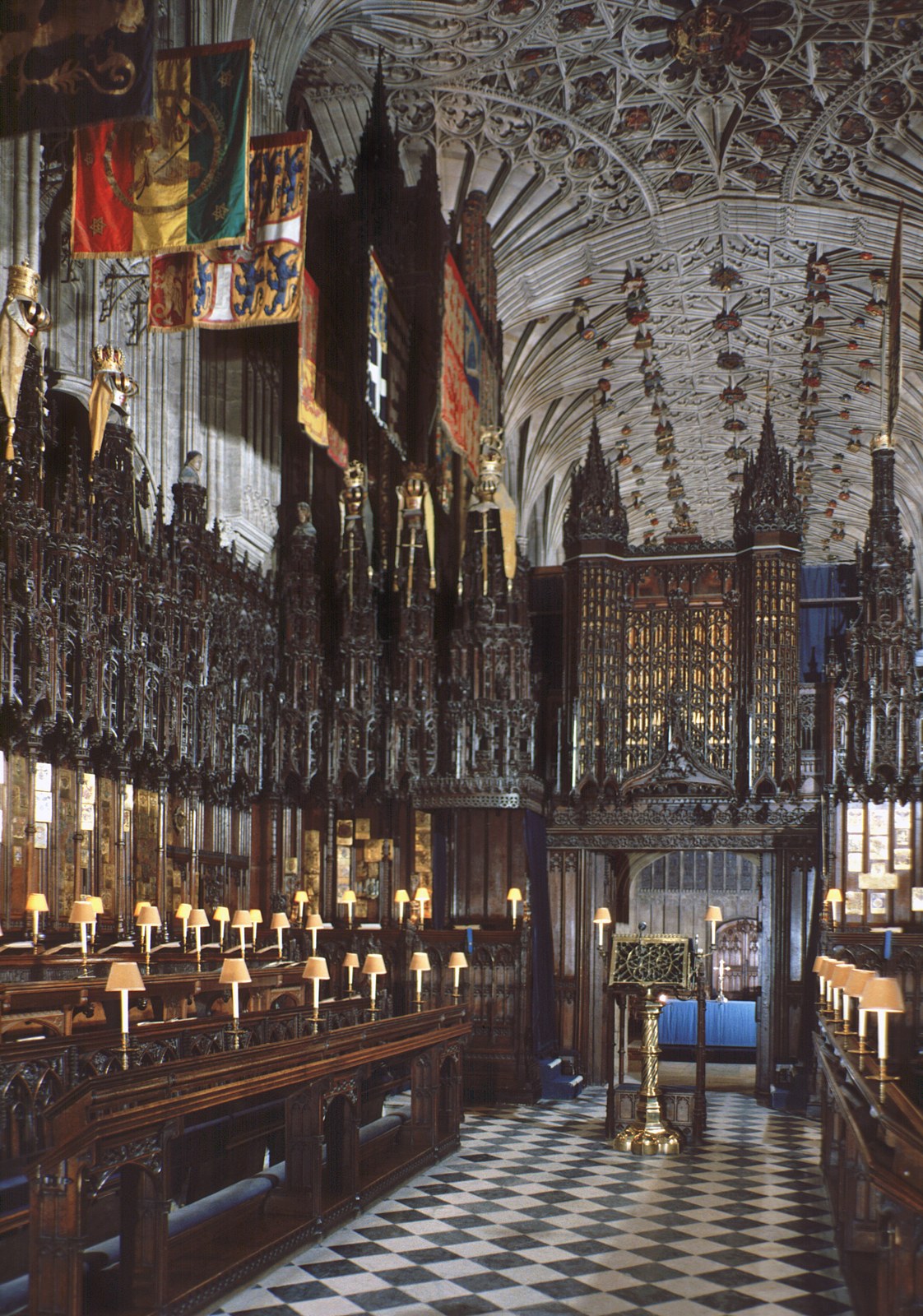
The photograph records a moment in that process. Its exposure date does not date every object in the room, and a current list of members cannot be used as a retrospective inventory of the banners shown. To identify an individual display, connect a visible component with a dated stall or installation record. To explain the room’s apparent continuity, examine the different ways its architecture, permanent plates, and replaceable personal displays persist.
A folded banner also makes incomplete evidence conspicuous. The cloth can hide part of a charge, turn an edge away, or overlap another banner. Lighting and photographic reproduction affect visible color. A viewer can record the observable arrangement without completing every design from memory. A clear photograph of the room is not necessarily a complete photograph of any single coat.
The same institutional account describes nineteenth-century stained glass representing Anne of York’s marital arms. That separates the depicted fifteenth-century relationships from the glass’s manufacture. The later object commemorates earlier people. Dating the glass from the lifetime of the persons represented would confuse subject and support, just as dating a modern portrait from the sitter’s birth would.
This ensemble also includes badges, cyphers, livery colors, and architectural arms. A crowned initial is not automatically a crest; a recurring color is not necessarily a shield’s field; a badge can indicate service or affiliation. The categories cooperate in the space without becoming synonyms. An account of the chapel’s visual identity should therefore inventory several kinds of sign and explain how each operates.
A public symbol can make a new historical argument
South Africa’s government dates the launch of its current national coat of arms to 27 April 2000 and explains the change in relation to democratic transformation. Its account identifies figures drawn from Khoisan rock art and a motto in the language of the /Xam people. These are attributed official explanations of a particular composition, not meanings we should infer merely from a shield’s outline.7
The case expands the questions a heraldic study must ask. Who selected the design? What accounts describe the represented figures? How does the official text name the language and explain the motto? Which evidence concerns the design’s adoption, and which concerns the older visual or linguistic material it uses? The national emblem brings those histories together, but it does not erase their differences.
A European category such as “supporter” may help describe one compositional relationship while failing to explain the source of a figure’s cultural authority. Begin with the named communities, objects, and institutional accounts. Then identify where heraldic comparison helps. Otherwise the researcher risks translating the entire emblem into familiar vocabulary and losing the very histories that make it distinctive.
The government’s symbolism statement is also one layer of interpretation. It establishes what the government says the emblem expresses. Studying the design’s reception would require evidence from audiences, publications, communities, or other dated sources. Neither unanimous acceptance nor controversy can be deduced from the symbolism page. A public emblem may participate in debate, but a historian must find the debate rather than write it into existence.
Institutional continuity needs a bearer history
The Universities Canada record supplies a useful example of continuity through a change of name. Its confirmation refers to an earlier record, while its commentary relates the design to the institution’s history. A study should preserve the name history, the dated act, and the design history as connected but separate strands.4
This becomes more complicated when institutions merge. A new body may combine predecessor functions and choose an armorial composition recalling both. Alternatively, it may receive or adopt a wholly different emblem, or continue an earlier one through a documented act. Shared staff, a familiar name, and occupied buildings can suggest continuity, but they do not independently establish the emblem’s formal status.
The Dutch public-body framework provides an institutional route for examining such questions. The Hoge Raad van Adel’s regulatory overview treats public arms through dated decisions and discusses provisions relevant to new bodies and earlier names. The historian should seek the actual decision for the municipality under study rather than infer an automatic transfer from a modern map.8
Distinguish legal continuity from visual continuity throughout. A new institution can keep an old-looking emblem; the same institution can adopt new artwork; an old institution’s arms can survive on property no longer belonging to it. The picture is evidence of a display. Its relationship to a continuing bearer needs documents. That distinction makes it possible to tell a coherent history without demanding that every visual change be a new institution or every familiar shield prove an unchanged one.
Cloth changes the composition’s practical demands
A banner of arms extends the shield’s design across a textile field rather than merely placing a small shield in the middle of an unrelated background. Its proportions and viewing conditions differ from those of the shield. Charges must remain recognizable when the fabric moves, folds, or is seen from below. A rendering that works on a flat page may become much harder to read in a hanging cloth.
The technical question is which relationships must survive that adaptation. Preserve the field’s organization, the charges’ count and identity, and specified orientations. Adjust spacing and figure proportions where the support requires it. If the adaptation makes a charge disappear into a fold in a particular photograph, that is a condition of that witness; it is not permission to remove the charge from the design.
The two sides introduce another issue. A photograph through a translucent textile can reverse a design, while a separately constructed reverse can follow its own production arrangement. Record which side and method are evidenced before diagnosing an incorrect orientation. A mirrored photograph is a different problem from a deliberately specified sinister-facing figure. The object history and photographic metadata can distinguish them.
For a practical exercise, compare a documented shield and banner for the same bearer. Draw boxes around their occupied regions, mark the centers of their charges, and compare normalized positions rather than raw centimeters. The purpose is to explain how the design adapts. A perfect geometric overlay is not the test of armorial identity, but the exercise can reveal where a careless adaptation has changed a relationship.
Stone, glass, and metal preserve different evidence
A carved stone can retain a silhouette after its paint has vanished. A glass panel can preserve colored pieces while replacing damaged leading or inserting later repairs. A metal seal matrix can preserve incised details whose impression appears reversed. These supports are not simply interchangeable containers for the same picture. Each can preserve some features clearly and leave others uncertain.
Begin with material observations before completing the arms. On stone, distinguish an actual carved boundary from a crack or later joint. On glass, distinguish a lead line from an intended division in the design. On a seal, distinguish the matrix from the resulting impression and record which you have inspected. Then compare the object with a dated description or another witness where the uncertain feature is clearer.
Restoration belongs in the chronology. A repainted charge can be old in shape and new in color; a replacement glass piece can preserve a proposed reconstruction rather than original material; a cleaned metal surface can make previously obscured details visible without changing the incision. A conservation report helps identify these events. Without it, the present photograph may combine several moments that a simple date label cannot untangle.
This is why the stained-glass study retains the museum’s object number, date range, medium, and limits of attribution. The collection record helps locate a physical witness and attributes information to a responsible source. It does not authorize us to name a patron from a resemblance or reconstruct the entire original window without additional evidence. A small fragment can answer a well-posed question without answering every question about the building it once occupied.
The small screen is another material condition
A website icon has very little room. Fine lines, small attributes, motto lettering, and complex external ornaments may disappear at ordinary display sizes. The design task is to identify an appropriate recorded component or permitted simplified form and render it clearly. Shrinking a full achievement until its text becomes microscopic preserves the file’s contents while losing its communicative function.
That does not mean every simplification remains the same arms. Omitting external elements may preserve a shield component, while deleting one of three principal charges changes the shield’s described composition. A derived institutional mark may be legitimate within brand guidance but should be named as a derived mark. State the relationship instead of forcing every size into the same category.
Text matters here as much as drawing. An image’s alternative text can identify the bearer and summarize the depicted component without pretending to be a full scholarly edition. A linked description can provide the complete blazon and source. For a complex diagram, explain the relationships in nearby prose as well. Readers who cannot see the image should still be able to follow the argument it supports.
Contrast must be evaluated in the actual presentation. A fine gold outline on a pale interface, faint explanatory text, or a small inscription can become unreadable even when the heraldic palette is conventional. Test normal sizes and different backgrounds. The criterion is whether the reader can recover the information the page claims to communicate. Heraldry began as identification; making the explanatory paragraph impossible to read is an especially unhelpful tribute to it.
Image rights and emblem authority travel separately
The images in this chapter have documented reuse bases. The Met’s public-domain object photograph comes through its Open Access program; the 1983 chapel photograph was released to the public domain by its author. Those records concern the images. They do not make the depicted families’ arms or Garter insignia the user’s own emblems.
Keep a rights ledger for public work. Identify the image file, source, creator where known, stated license or public-domain basis, required credit, and any conditions relevant to the proposed use. Then separately identify any institutional restrictions or claims arising from the emblem’s context. An image can be reusable in an educational account without being suitable as a badge implying membership or endorsement.
Do not confuse the artwork’s age with the photograph’s status. A centuries-old object can have a newly created photograph whose rights need checking. A modern photograph can have an explicit open license. Read the file record rather than assigning a rights category from the date of the depicted coat. The record should let someone else recover both the image and the basis on which you used it.
Four problems in public display
1. A diploma becomes personal arms
Constructed problem: a graduate reproduces the university’s shield and calls it “my inherited arms,” citing the diploma. What relationship does the diploma actually support?
Answer discussion
It can support the institution’s use of the emblem on the credential and the graduate’s documented academic relationship, depending on the object. It does not establish personal inheritance of the institutional arms. Record affiliation and armorial bearing as different propositions.
2. A present list identifies a 1983 room
Use the chapel photograph and the College’s explanation. Why is a current list of Garter members insufficient to identify every banner in the archived view?
Answer discussion
The view records a dated arrangement within a changing display system. Seek contemporary stall or banner records and compare visible designs. Folded or obscured features remain unresolved. A current list answers a current membership question, not automatically a historical installation question.
3. A lead line becomes a partition
Constructed problem: a glass panel contains a structural lead across a charge. A transcription describes the coat as divided by that line. What should be checked?
Answer discussion
Compare the line’s structural function, the surrounding design, a conservation record, and another armorial witness. A physical join may intersect the image without belonging to its heraldic specification. Preserve the join in the material description and qualify the proposed partition until supported.
4. Open image, asserted endorsement
Constructed problem: a designer finds an openly reusable photograph of an official emblem and places it where the page implies governmental sponsorship. What has the image license answered, and what has it left open?
Answer discussion
The license concerns reuse of the image under its stated terms. It does not establish the claimed institutional relationship. Examine the actual emblem rules and the context of the use. The design’s message and the photograph’s copyright status are different questions.
Research project: a public emblem in use
Choose a public or corporate emblem with a documented adoption or armorial act. Find three dated uses in genuinely different media, then map the institution, design, component, physical object, and function for each. Add a source for the emblem’s specification and an attributed account of its intended meaning. Record any conservation, replacement, or institutional change that affects the comparison.
Write an argument about one concrete adaptation: how an ordinary changes proportions on a banner, how a seal’s legend identifies an office, how a building preserves an earlier design, or how a digital mark relates to the arms. Include one feature that the evidence cannot resolve and propose the source most likely to help. The project succeeds when the reader can explain why the displays differ while understanding which identity remains continuous.
Workshop: follow one emblem across three media
Choose a documented civic or institutional coat and find three dated uses. Record the object, bearer, medium, source, and whether the design was altered or merely adapted. Write a short argument about continuity and change. Include one case where the source does not let you decide.
Assessment should reward the distinction between a formal act and a visual adaptation, proper attribution of symbolism, and preservation of the objects’ dates. It should not reward finding the greatest number of vaguely similar pictures. Three securely identified witnesses can support more scholarship than thirty untraceable images.
Footnotes
-
Fox-Davies, A Complete Guide to Heraldry (1909), chapters XXIX–XXX, badges and heraldic flags. Historical terminology; modern logos require their own institutional documentation. ↩
-
National Archives, Original Design of the Great Seal of the United States (1782), account of adoption and documentary function; consulted 8 October 2026. ↩ ↩2
-
U.S. Department of State, Foreign Affairs Manual, 2 FAM 152.1 and 152.2-1, description, custody, authentication, and unofficial use of the Great Seal. Published text consulted 10 October 2026; retain the manual’s distinctions among seals and uses. ↩ ↩2
-
Governor General of Canada, Universities Canada, confirmation of arms, supporters and badge, 15 May 2015, vol. VI, p. 503, shield blazon and symbolism; consulted 8 October 2026. No artwork reproduced. ↩ ↩2
-
The Metropolitan Museum of Art, Heraldic Shield, 12.137.2, collection record; consulted 8 October 2026. Catalogue-mediated study; no new bearer attribution claimed. ↩
-
College of St George, Heraldry in St George’s Chapel, institutional account of component retention, reused display helms, and later commemorative glass; consulted 10 October 2026. Its named photographic examples are historical witnesses, not a current membership inventory. ↩
-
South African Government, National Coat of Arms, official account of the 27 April 2000 launch and attributed symbolism; consulted 10 October 2026. This chapter analyzes the account’s source role rather than claiming an independent study of all cultural materials or public reception. ↩
-
Hoge Raad van Adel, Regelgeving overheidswapens, dated public-body provisions and institutional overview; consulted 10 October 2026. A specific municipal continuity claim requires its own decision. ↩
Read beyond this lesson.
Follow these sources when you want to examine the underlying rule or argument. Note the place, period, and institution each source describes before applying it elsewhere.
- College of Arms — Granting of Arms ↗ — Official treatment of arms for corporations and other bodies.
- College of St George — heraldry in the chapel ↗ — A changing ensemble with different kinds of sign and material witness.
- South African Government — national arms ↗ — A dated public adoption and attributed official symbolism.