✦ A substantive research chapter
A cup on a stand identifies more than a drink
The Met’s tray stand 91.1.601, dated after 1342, carries an inlaid cup emblem and an inscription naming Husain, son of Qawsun. The museum connects the cup with Qawsun’s office as cupbearer and explains its continued use by his sons.1 One object therefore brings office and family into the same account. The cup’s function as an emblem cannot be explained solely by the practical use of the vessel it depicts.
The word blazon needs attention here. In a European heraldic lesson it commonly means the verbal specification of arms. In the consulted Mamluk catalogues it can identify an emblem, including a figured or epigraphic device. Preserve the catalogue’s use before translating it into another system’s categories. Similar vocabulary gives us a comparative question; it does not settle the historical relationship.
The central inquiry is how a device connects a person with office, patronage, family, or rule. A cup, a divided field, and an inscription can organize those relationships visibly. The design participates in a political setting whose offices and succession practices need their own explanation. The comparative value lies in seeing that mechanism clearly rather than importing an English pedigree formula because the device occupies a shield-like space.
The sultanate supplies the institutional setting
Suzan Yalman’s museum essay places the Mamluk sultanate in 1250–1517 and describes a military ruling structure whose succession did not depend entirely on hereditary family succession. It also connects artistic production with elite patronage, trade, and endowed public and religious foundations.2 This setting helps explain why office and personal prestige can be central to emblematic display.
An office emblem identifies a relationship between a person and an institutional role. A hereditary family emblem identifies another relationship. In practice, prestige and family continuity can make the two overlap, as the cup case suggests. A classification with only “official” and “hereditary” boxes would need room for such a documented intersection. The evidence should determine how the case is described, rather than being trimmed to fit a binary chart.
Patronage adds a further audience. A named elite patron’s device on an object or foundation can perpetuate identity beyond the immediate act of commissioning. It can be seen by household members, visitors, religious communities, or later viewers. The medium and location shape that audience. A portable metal object and a building inscription can share identifying forms while making different kinds of public presence possible.
Look at the cup within its object
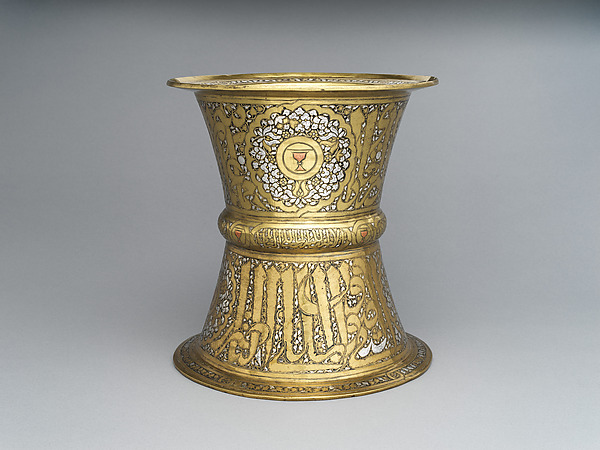
The photographed cup sits within a bounded decorative area on the upper section. Large inscriptions and further ornament occupy the surrounding metal surface. Those observations keep the emblem in a designed environment. Its scale and placement allow it to participate in a composition that also identifies through writing. The object presents more than one route to recognition.
The catalogue attributes the stand to Egypt or Syria and identifies brass with silver, copper, and black-compound inlay.1 Retain that geographical alternative. The object’s materials explain the visible differentiation of surfaces; the inscription’s reading supplies the named relationship. Visual observation and catalogue interpretation can be recorded together without pretending that a web photograph constitutes a new technical examination or Arabic transcription.
The continued use by sons is the key complication. A device tied to a court role can persist within a family after the role’s original occupant is gone. That observation encourages an inquiry into prestige and transmission. It does not establish that every court emblem follows the same pattern. The next useful comparison is another named object with a documented relationship, rather than an unsourced chart of every possible office symbol.
A textile fragment changes the encounter
The Met’s wool fragment 1972.120.3 is dated to the late fifteenth or early sixteenth century and associated with Qaitbey or a successor. The museum proposes clothing or furniture as its original support.3 Those alternatives produce different possible encounters with the same emblem: a design moving with a wearer or a design encountered in a furnished space.
The fragment’s incomplete condition should remain visible in the explanation. Its present dimensions describe what survives. They do not supply the dimensions of the lost garment or furnishing. A reconstruction needs evidence of edges, attachment, seams, and comparisons. We can study the preserved emblem before resolving the entire original object, while stating which relationship remains uncertain.
Material also changes production. Appliquéd and embroidered wool permits different edges and surfaces from metal inlay. Similar emblems can be realized through different techniques without requiring identical details. Comparing the compositions should therefore distinguish identifying components from medium-specific treatment. A stitch boundary and an engraved line can do related visual work without having the same manufacturing history.
Writing can occupy the emblematic center
The Mamluk plate 2018.472, dated approximately 1412–1421, bears an epigraphic blazon naming Sultan al-Mu’ayyad Shaikh. The catalogue also identifies an artist’s signature.4 The identifying center is organized through inscription, rather than a cup or animal charge. Text participates directly in the emblem’s visual and political work.
The two names have different roles. The ruler’s identification concerns the patron or authority presented by the object. The artist’s signature concerns its making. A database that extracts every proper name into an undifferentiated “owner” field would lose both relationships. Record the inscription’s location and the catalogue’s interpretation of each role before joining the names into a provenance narrative.
This case also corrects a narrow visual definition of an emblem. An identifying system can use writing in a strongly organized form. A viewer might recognize the overall arrangement before reading every word; a reader can obtain further information from the text. The same object therefore offers different amounts of information to different audiences. Legibility and recognizability are related capacities with different requirements.
Comparison without a borrowed rulebook
| Witness | Principal device in the account | Relationship to investigate |
|---|---|---|
| Husain’s tray stand | Cup emblem and inscription | Court office, paternal prestige, and continued family use |
| Wool fragment | Mamluk emblem on a lost larger support | Patronage attribution and the original audience |
| Sultan’s plate | Epigraphic central device | Ruler identification and a separate maker signature |
The cases share emblematic identification, but they do not prove one uniform system of descent or difference. The cup case supplies a family connection; the plate supplies named authority through writing; the textile preserves a design with an uncertain original setting. A comparative account should explain those differences before trying to classify all three as versions of European coats of arms.
The Ottoman tughra chapter follows a different calligraphic apparatus of royal identification. The tamgas chapter supplies small marks on several materials. Together, these chapters let us compare what designs identify and how audiences read them while preserving the institutions and histories that make the identification work.
The bow-keeper gives the comparison another office
The Met’s lamp 17.190.985, dated shortly after 1285, carries two gold crossbows against red. The museum relates the figure to the office of bunduqdar, keeper of the bow, and reads its inscriptions as identifying Aydakin’s mausoleum as the intended destination.5 It supplies a different office emblem and a more specific architectural association than the cup case alone.
The crossed weapons are depicted figures, not actual weapons fastened to the lamp. Their emblematic work depends on recognition of the office relationship. The lamp’s illumination and the bow-keeper’s court role are different functions brought together by patronage. The object need not be a piece of military equipment for its decoration to identify a military or ceremonial official.
This is an important limit to interpreting objects solely by their everyday purpose. A vessel can carry an emblem whose referent lies outside dining; a lamp can carry one whose referent lies outside lighting. The support provides an occasion for identity to appear. We should explain how the device relates to the patron and commission instead of assuming the pictured tool describes the object’s use.
The inscription adds information that the motif cannot supply alone. Two crossbows establish a proposed office association in the cited account. The name and destination link this particular lamp to a more specific history. Replacing the inscription with a tidy museum label saying only “bow-keeper badge” would remove part of the surviving evidence. Read the emblem and writing as coordinated means of identification.
The polo master appears on pottery
The Cairo museum’s ceramic record identifies two polo sticks on the surviving bottom of a glazed vessel and connects them with the al-Jokandar office.6 The form belongs to another court relationship and another manufacturing medium. It helps us move beyond a single office and beyond elite metalwork.
The fragment’s survival gives a useful material boundary. A bottom can preserve an emblem while the rim, handles and much of the wall are gone. That allows study of the mark without establishing the complete vessel’s dimensions or precise handling. A reconstruction should identify which features are observed and which are supplied through comparison. The emblem’s survival does not make the missing parts irrelevant.
Nor does an office association identify one particular person without additional evidence. Many people can hold the same kind of office over time. The generic relationship gives us a classification; a name-bearing inscription or secure archaeological context can refine it. This is the same analytical distinction encountered in a Han seal naming a general’s office and in a Qing rank badge. The devices differ, but category and individual remain different questions.
The pottery also gives a productive comparison with the bow-keeper’s glass lamp. Two depicted implements can communicate a court role within a bounded area. Their meanings depend on a documented convention, and their production depends on different materials. We can compare the mechanisms without claiming that every similar pair of crossed strokes has the same origin or referent.
Qawsun’s patronage extends across supports
The Met dates Qawsun’s glass lamp 17.190.991 to about 1329–1335. Its name-bearing inscription connects it with the patron, while the museum proposes either his mosque or tomb-hospice complex as its intended architectural setting.7 Retain that alternative. The record provides a strong named association without establishing the exact original hanging position.
Set it beside the tray stand associated with Husain, Qawsun’s son. The two objects enter a family-centered research sequence through their names and the cited institutional accounts. The comparison is richer than simply finding cups on two surfaces. It can follow a patron’s public commission and a later use associated with his son, then ask which identifying relationships remain stable.
The material audiences differ. A stand holding a tray participates in presentation and service. A hanging lamp participates in an architectural interior. The emblem’s visibility depends on placement, scale and lighting in each setting. A photograph on a white museum background removes much of that encounter. The catalogue’s suggested destination helps restore context while leaving precise installation unresolved.
This is also where the family question becomes historically interesting. The earlier office relationship can contribute prestige that later relatives continue to display. We should investigate that documented sequence rather than forcing it into either a purely personal appointment badge or a fully standardized European system of hereditary arms. The surviving objects may reveal a relationship that cuts across those convenient categories.
A composite blazon has an internal grammar
National Museums of Scotland’s dish A.1923.700 carries a divided composite device: a napkin above, a cup bearing a pen-case between horn-like figures in the middle, and another cup below. The curatorial account associates this type with Qaytbay, officials and successors, supporting a late-Mamluk date range.8 Its composition should be read as an arrangement, not a list of interchangeable office symbols.
Begin with the fields. A figure in the upper area and a figure in the lower area have different places even when both contribute to the same identifying system. Now examine the central cup: the pen-case is placed on it, not merely beside it. A diagram omitting that relationship would preserve the component inventory while changing the device. Spatial grammar is part of the evidence.
The two cups supply another useful detail. Repetition does not necessarily mean redundant decoration. One cup occupies the central composite relationship; the other occupies the lower field. If an artist combines them into one larger cup, the result may look cleaner while failing to reproduce the described arrangement. A modern educational diagram should clarify the source, not redesign it silently.
The type’s association with several rulers and officials also limits attribution from shape. If a device was used across a broader political group, finding it does not uniquely identify Qaytbay as the object’s personal owner. The inscription and the rest of the object record remain important. Classification can narrow the historical setting without resolving the individual bearer.
The dish’s account also preserves uncertainty in an inscription on the underside.8 That is useful evidence rather than a defect to hide. A proposed reading can guide a research question while remaining qualified. An unreadable word should not acquire certainty merely because the surrounding emblem belongs to a familiar type.
Glass introduces a technical history of visibility
The Met’s technical essay explains that gold and powdered enamels were applied to glass and fixed through heating. It presents combined firing as a likely solution to the differing thermal requirements and risks of repeated reheating.9 The account distinguishes an observable decorated surface from a reconstructed workshop procedure.
That distinction matters for the blazon. Color differentiation on a glass lamp can depend on applied decoration, uncolored glass and transmitted light. Metal inlay works through another relationship between surface and contrasting material. A black-and-white outline drawing can preserve the emblem’s organization while concealing how the actual support made it visible. Comparing devices across media therefore needs both a component description and a material account.
The proposed firing procedure is also a good example of historical technical reasoning. Surviving objects demonstrate a result; physical constraints help explain how it might have been achieved. The inference should remain tied to the essay’s degree of confidence. We should not convert “likely” into a claim that every workshop followed one documented recipe. A reference becomes stronger when it explains the mechanism and preserves the precise uncertainty.
Epigraphic identity belongs beside figured devices
The plate naming al-Mu’ayyad Shaikh gives this chapter a different identifying center: an inscription rather than a depicted implement. Its engraved decoration and separate maker signature demonstrate that a name-bearing emblem can coexist with other writing on the same object.4 The difference concerns the work each inscription performs, not whether one is sufficiently pictorial to count.
Compare it with the composite dish and the office lamps. The figured devices invite identification through a conventional object or arrangement. The epigraphic center invites reading of a named authority. Either can also be recognized at the level of overall composition before every detail is understood. A literate and a non-reading viewer may obtain different information from one object; that does not make writing merely an ornamental substitute for a coat of arms.
For an advanced exercise, prepare a corpus with one cup, one bow-keeper device, one polo motif, one composite and one epigraphic center. Record what identifies a category and what identifies a person. Then compare the material supports and the evidence of audience. This corpus is deliberately small enough for close reading and broad enough to test the claim that all Mamluk blazons perform one identical function.
Can a composite device identify its owner alone?
Only where the relevant evidence supports an exclusive association. The Scottish dish’s catalogue connects its type with a broader group, so an individual identification needs further witnesses. Its arrangement can support classification and dating while its inscription supplies another line of inquiry. Retain the value of the device without asking it to answer a question for which it is not unique.
Workshop: office and family can overlap
Using the tray-stand record, write one statement about the cup’s documented office association and another about its continued use by sons. Then compare two hypotheses: a strictly office-only system and a system in which office prestige can contribute to family identity. State which hypothesis the particular case complicates and what a larger test would require.
Discuss the overlap
The catalogue explicitly connects the cup to Qawsun’s office and its continued use by his sons. That case complicates a universal office-only interpretation. It supports investigating a family dimension here, while a general transmission model needs a larger corpus of named objects, dates, and relationships. One documented exception can defeat an absolute rule without establishing the frequency of the alternative.
A second exercise compares the named ruler and maker on the plate. Design a catalogue entry with separate role fields and explain which evidence would be required to add ownership or commissioning claims beyond the museum’s account.
Graduate project: a device across supports
Choose one documented emblem and assemble occurrences on at least two supports. Record their inscriptions, named relationships, dates, materials, and attribution confidence. Ask which components remain stable and whether the audience or institutional function changes. Where a full inscription is essential, commission or develop a competent transcription and translation apparatus rather than relying on a cropped illustration.
The project should explain a particular transmission or change of function. Include rejected or unresolved identifications so the corpus’s boundary can be checked. A strong conclusion can show how office and identity are connected in one historical sequence without turning that sequence into a universal model for the entire Mamluk world.
Footnotes
-
The Met, Tray Stand, 91.1.601, inscription and cupbearer/family interpretation. ↩ ↩2
-
Suzan Yalman, The Art of the Mamluk Period (1250–1517), October 2001. The consulted essay is English despite the URL’s French prefix. ↩
-
The Met, Textile Fragment with Mamluk Emblem, 1972.120.3, qualified date, attribution, and support. ↩
-
The Met, Mamluk Plate, 2018.472, ruler and artist identifications. Sources consulted 11 October 2026; interpretations are catalogue-mediated unless expressly identified as observations of the reproduced photograph. ↩ ↩2
-
The Metropolitan Museum of Art, 17.190.985, Mosque Lamp for the Mausoleum of Amir Aydakin al-‘Ala’i al-Bunduqdar. Consulted 11 October 2026. Original English editorial synthesis; consult the linked record for close reading. ↩
-
Museum of Islamic Art, Cairo; Museum With No Frontiers ceramics catalogue, Bottom of a pottery vessel with polo-stick blazon. Consulted 11 October 2026. Original English editorial synthesis; consult the linked record for close reading. ↩
-
The Metropolitan Museum of Art, 17.190.991, Mosque Lamp of Amir Qawsun. Consulted 11 October 2026. Original English editorial synthesis; consult the linked record for close reading. ↩
-
Ulrike Al-Khamis, National Museums of Scotland, A.1923.700; MWNF, Dish (National Museums Scotland, A.1923.700). Consulted 11 October 2026. Original English editorial synthesis; consult the linked record for close reading. ↩ ↩2
-
Stefano Carboni and Qamar Adamjee, Metropolitan Museum of Art, October 2002, Enameled and Gilded Glass from Islamic Lands. Consulted 11 October 2026. Original English editorial synthesis; consult the linked record for close reading. ↩
These essays are original English-language syntheses with visible archival and institutional citations. They have not been independently reviewed by regional specialists. Readers should check consequential assertions against the linked source language and current law.