✦ A substantive research chapter
A signature can be recognized before it is read
The Met’s tughra associated with Sultan Süleiman, dated approximately 1555–1560, arranges calligraphic lines into a striking configuration of loops, shafts, and horizontal strokes. Its catalogue explains that a tughra typically includes the ruler’s name, his father’s name, title, and a victory formula.1 The writing identifies a particular ruler while the configuration makes royal identity visually recognizable.
This is a useful comparative problem because reading and recognition are different skills. A viewer can recognize the arrangement without deciphering the ruler’s complete name. Another viewer can read the text and distinguish the particular bearer. The design organizes information so different audiences can obtain different levels of identification from the same surface.
A tughra is therefore studied here as an Ottoman calligraphic insignia with its own institutional history. The comparison with heraldry concerns how identity and authority are made visible across materials. It does not require inserting the tughra into a European shield or calling its vertical shafts crest feathers. The form already has enough work to do on its own terms.
Look at the whole surface
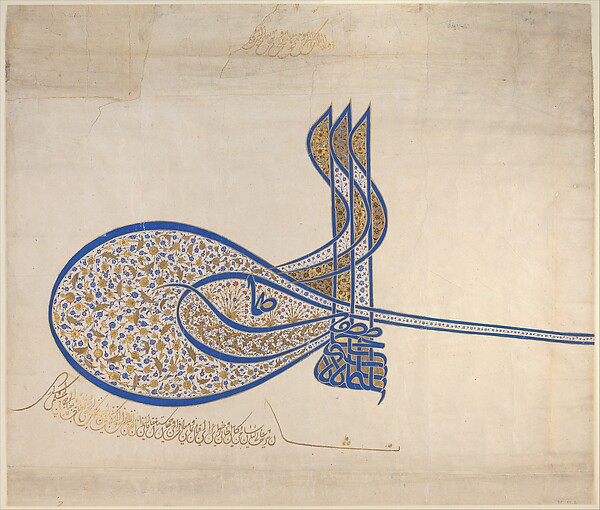
The image shows ornament within the calligraphic configuration, not merely a plain signature with decoration pasted beside it. Gold and blue shapes occupy the interior spaces while the larger outline remains legible as a configuration. That observation gives us a design question: how much internal elaboration can a recognizable form carry before its defining structure becomes difficult to perceive?
A reduction experiment can answer part of that question. View the reproduced image at a small size, then at full width. Record which large components remain recognizable and which floral details become indistinct. The exercise examines this photograph’s visual behavior. It cannot establish every historical viewer’s literacy or viewing distance, but it can make the distinction between overall recognition and detailed reading tangible.
The catalogue identifies ink, opaque watercolor, and gold on paper.1 Those materials support both line and ornament. A coin bearing a tughra works under different constraints: small relief, limited space, wear, and manufacture through dies. Comparing the two means following the identifying configuration through a changed support, rather than demanding identical microscopic detail.
The name changes within a recognizable arrangement
The ruler’s name and patronymic connect the insignia with a particular person and dynasty. A successor needs a different identifying text even where the arrangement remains recognizably Ottoman. The design must therefore balance continuity of institutional form with distinction between bearers. The problem resembles other emblem systems at that level, though the specific solution is calligraphic.
Model the relationship with an invented writing exercise. Two officeholders use the same general frame, but each inserts a different name. If the writing changes too little to distinguish them, identity weakens. If the entire arrangement changes, institutional recognition may weaken. The task is to preserve a shared visual grammar while making the bearer-specific information available to an informed reader.
This model also clarifies what a copy establishes. A later artist can copy the configuration of an earlier ruler’s tughra as a historical or decorative subject. The copied name does not make the later object a royal edict issued by that ruler. The context, date, document type, and issuing act still matter. Recognizable authority can be represented in art without performing the authority’s original administrative function.
Selim III’s panel has two signatures with different jobs
The National Museum of Art of Romania’s collection account identifies a Selim III tughra panel dated AH 1208 / 1793–1794, inventory 12397 / 1054. It distinguishes the ruler’s insignia from a lower cartouche containing the calligrapher Muhammad Sadiq’s signature and date.2 The object presents royal identity and artistic authorship on one surface.
Those relationships should receive different fields in a catalogue. Selim III is the ruler named by the insignia. Muhammad Sadiq is the maker identified by the signature. The museum’s later custody and transfer history form another layer. Calling every named person an “owner” would produce an imaginary provenance in which the calligrapher, ruler, and repository perform the same role.
The separate panel also changes the function under investigation. A tughra attached to an issued document can participate in royal authorization. A panel can present the insignia for visual contemplation or display. To establish a particular use, investigate the object’s original setting and documentary history. The form’s relationship to royal identity is clear; the function of each surviving support remains a case-specific inquiry.
The date conversion is another useful discipline. AH 1208 spans parts of two Gregorian years, which the catalogue renders as 1793–1794.2 Preserve that interval. An English catalogue that selects one Gregorian year without explanation has introduced precision the consulted record did not supply. Different calendars can express the same date through different ranges.
Coins can become jewellery
The Met catalogues a late-eighteenth-century gold pendant incorporating coins from Istanbul dated 1788–1789 and bearing Selim III’s tughra. It proposes a bridal association and probably Turkey or Iraq as the object’s geography.3 The coins’ identifying design moves into a personal adornment with additional possible economic and protective functions.
The chronology needs two layers. A coin’s dated issue concerns one component. The pendant’s assembly concerns the larger object. A coin can be incorporated after its issue, and a group of components can have different dates. The earliest component therefore supplies a chronological constraint for the assembly, not an automatic exact date for it.
Function changes in a similarly layered way. The coin retains an image created in a monetary and sovereign setting. Its new placement can make it part of ornament, stored value, or a protective arrangement, as the catalogue proposes. The political identity does not vanish when the object is worn, but it now participates in a different encounter. That is why following an emblem through supports can reveal more than a sequence of stylistic copies.
A careful account retains the museum’s qualifications. A probable bridal use is a proposed interpretation, not a documented name of the original wearer. A Turkey-or-Iraq attribution is an alternative, not two proven places of manufacture. Those distinctions make the object a better research starting point by preserving the questions its surviving form cannot answer alone.
Compare royal identity with other systems
The Mamluk chapter includes an epigraphic blazon naming a ruler and a separate artist’s signature. The Chinese seals chapter follows names, studio identities, and collector relationships impressed on artworks. These comparisons concern the roles writing can perform inside visual identification.
Writing can identify the issuer, maker, owner, office, or commentator. The same name may have different roles on different objects. A comparative catalogue should record the role and evidence rather than merely collecting transcribed proper names. Once the roles are separated, we can investigate how textual identity becomes recognizable through a designed form.
The institutions remain necessary to the explanation. A royal insignia, private artist’s seal, and collector’s mark operate within different conventions. Their resemblance as elaborate writing does not establish the same authority or succession practice. The useful shared question is how form, text, support, and audience cooperate in the particular act of identification.
The configuration has named parts
M. Uğur Derman’s Turkish study distinguishes the lower sere or kürsü, paired beyza loops, extended kol or hançer, three vertical tuğ shafts and descending zülfe curves.4 The vocabulary lets us describe the architecture of a tughra without calling every stroke an independent decorative flourish.
| Part | Place or relationship in the described arrangement |
|---|---|
| Sere / kürsü | Lower arrangement carrying names and formula |
| Beyza | Nested loops extending to the left |
| Kol / hançer | Extension toward the right |
| Tuğ | Three ascending shafts |
| Zülfe | Curves descending from the shafts |
The parts are connected through writing. A loop and shaft can contribute to both a letter-based construction and the recognizable outline. The design is therefore not a plain name placed inside a separate ornamental frame. To reconstruct it, the reader needs the relationship between text and configuration. A lettering diagram should identify that relationship rather than presenting the parts as detachable heraldic charges.
The three shafts are particularly instructive. Derman notes that their number remains three despite variation in the number of relevant letters in the text.4 The recognizable configuration imposes a compositional convention as well as recording words. This helps explain why reading the name and recognizing the form are related skills with different demands. The artist works with a conventional arrangement, not an unrestricted string of ordinary handwriting.
An educational tracing exercise can preserve the distinction. First identify the large regions and their connections in the reproduced object. Then consult a competent reading of the text. Record where the reading explains a shape and where conventional arrangement governs the visible extension. Do not assign Ottoman letter names to strokes merely because they resemble a diagram encountered elsewhere. The exercise should make the structure clearer while keeping the transcription attributable.
The early history precedes Süleiman
Derman identifies an early Ottoman tughra of Orhan dated 1324, describes development in subsequent rulers’ examples, and discusses Mustafa Râkım’s later reform of proportions and lettering.4 Süleiman’s elaborately illuminated example thus belongs within a longer history. It is an outstanding witness to a particular period, rather than the first moment at which Ottoman royal identity acquired a written form.
The distinction helps us read the Met’s introductory language about standardization. A museum summary can emphasize the composition familiar from a sixteenth-century masterpiece, while a specialist study follows the earlier formation of its parts. The two accounts operate at different scales. We should compare their actual claims instead of compressing them into an assertion that one ruler invented every feature.
The later reform also demonstrates that continuity of institutional function permits changes in design. Letter spacing, proportion and balance can be reworked while the configuration remains a tughra. This is a history of calligraphic decisions as well as one of dynastic names. A complete account needs makers and administrators alongside sovereigns, because the named ruler did not personally have to execute every surviving instance.
Derman identifies the nişancı among the officials responsible for drawing the royal insignia.4 That institutional role changes the meaning of “signature.” We should not assume the mark is ordinary autograph handwriting simply because it authorizes in a ruler’s name. The execution belongs to an administrative practice. Authorship of the royal name, production of the calligraphic form and authority for the document are connected roles that can be occupied by different people.
The Proteus decree makes an administrative act visible
British Library Or 11320 is catalogued as a decree to Istanbul’s customs and harbor authorities allowing the British vessel Proteus, commanded by John William James, to proceed with its cargo to the Black Sea. It bears Mahmud II’s tughra in black ink and is dated AH 1234, rendered as 1818–1819 in the catalogue.5 Here we can connect the insignia with a named transaction.
The complete document answers a question that an isolated ornamental panel cannot. The tughra identifies the royal authority; the decree’s text identifies what the recipient is being told to permit. The ship’s name, captain, cargo movement and addressed authorities place that authority into an administrative situation. An attractive crop containing only the tughra would retain the sovereign’s visual identity while losing much of the action.
The black ink also supplies an instructive contrast with the highly ornamented paper example. Administrative use does not depend on a maximum quantity of gold or floral illumination. Elaborate treatment can participate in presentation, but the document’s authority needs its institutional setting and issuing act. A plain instance should not automatically be demoted to an unofficial imitation because it looks less luxurious.
The date interval should remain an interval until more specific evidence resolves it. An AH year overlaps two Gregorian years; choosing one for a caption can create unsupported precision. The problem is manageable: retain the original date and give the catalogue’s conversion alongside it. If a day and month become available through competent reading, explain the conversion rather than quietly replacing the earlier record.
A decree can address protection rather than commerce
The catalogue of British Library Or 11688 identifies a firman to Istanbul’s kadı concerning protection of the Jewish community and religious observance. It bears Abdülmecit I’s tughra and is catalogued to AH 1256.6 The insignia performs a related royal-identification function while the document’s subject differs from the Proteus passage permission.
This broadens the comparison with Jewish armory. A community’s corporate banner identifies the community. A royal decree concerning that community identifies another authority acting in relation to it. Both can be relevant to the history of public identity without becoming the community’s own arms. The difference lies in whose act the device accompanies.
The catalogue account establishes the described subject, but a fuller legal or social history needs the decree’s complete text and its context. A protection order is evidence of a prescribed act. Demonstrating its implementation requires additional witnesses about what happened after issuance. The distinction keeps a history of documents from becoming a claim that the existence of an order proves universal compliance with it.
A surviving tughra may be only part of a document
The Met’s educator resource identifies accession 38.149.1 as a tughra formerly at the top of a long firman.7 This is a different accession from the chapter’s reproduced 38.149.2. Their related subject matter should not cause the first object’s stated documentary history to be silently transferred to the second.
A separated head of a document can preserve striking calligraphy while losing the operative text below. Its present proportions then belong to the surviving portion. Reconstructing the original document needs measurements, edges, conservation evidence or another record. The tughra can remain identifiable even when the specific command it once accompanied is no longer available through the displayed fragment.
This creates a useful comparison with the complete decrees. The Proteus description supplies a recipient and action; a fragmentary tughra supplies royal identity and artistry. These are different amounts of surviving information. The fragment’s beauty cannot restore the missing transaction, and the complete document’s administrative detail does not diminish its visual design. The reference should let each witness contribute what it preserves.
A modern Ferman makes the historical form a subject
Erol Akyavaş’s Ferman, Met 2017.236, is a 1992 acrylic painting. The museum’s curatorial discussion relates its elongated form to an Ottoman decree and describes its marks as pseudo-calligraphic, including reversed or inverted forms.89 This is a later artistic engagement with a document type, rather than a royal command awaiting execution.
The comparison shows how recognizability can survive a change in function and legibility. A viewer can encounter a visual reference to written authority without receiving a continuous readable decree. The painting asks for interpretation as an artwork. It can invoke the shape and associations of a firman while departing from the textual operation that made an administrative document actionable.
We should not invent a translation to make the painting fit the earlier model. Where the cited curatorial account identifies pseudo-calligraphy, the apparent script is part of the artistic construction. A transcription field can record that distinction. “Text unresolved” and “not presented as continuous readable text” are different findings. The first invites further decipherment; the second describes the kind of visual language the museum discusses.
The modern artwork also has its own reproduction rights, retained by the artist’s estate in the object record.8 An open-access historical tughra image does not confer rights over every later work engaging with that form. The catalogue link permits study of the modern comparison without treating its image as automatically available for the gallery. Rights follow the particular reproduction and object, just as the history follows the particular support.
Read authority, writing and support together
A final comparative exercise can put the Proteus decree, the Selim III panel and Akyavaş’s painting side by side through their linked records. Identify the name-bearing form, the surrounding text, the support and the proposed act. One accompanies an administrative permission; one presents royal identity in a calligraphic panel; one takes the document’s visual language as an artistic subject.
The comparison makes an operable model. A recognizable insignia identifies a historical authority, but the surrounding document and object history establish what this instance does. A later work can preserve the reference while changing the act. The strength of the tughra’s visual identity is precisely what makes those later uses possible; it does not make them all original royal issuances.
What would the crop conceal?
A crop of the Proteus decree could preserve Mahmud II’s identifying form while removing the recipient, ship and permission. That image remains useful for studying the tughra, but it no longer supplies the complete administrative transaction. A catalogue should connect the crop with the full witness and state which surface or portion is reproduced. The identity mark and the command belong to a related documentary act.
Workshop: ruler, maker, and later support
Construct a three-object comparison for Süleiman’s paper insignia, Selim III’s panel, and the pendant. Record the named ruler, maker where identified, date or range, support, and proposed function. Explain which fields establish royal identity and which establish the object’s separate material history.
Discuss the different roles
The tughra’s text identifies a ruler. A separate artist signature identifies a maker. The support and catalogue date concern the surviving object, which may present the insignia in a document, display, or jewelry setting. The pendant requires component and assembly chronologies. Those fields can be connected without assuming every support was an administrative instrument issued by the named ruler.
For a second exercise, compare the full-size paper image with a small rendering. Describe the retained configuration and lost detail without claiming to read letters you cannot resolve. Explain how recognition can survive a loss of detailed legibility.
Graduate project: one tughra across media
Choose one named ruler’s tughra and locate three dated occurrences on different supports. Obtain competent readings of the identifying text and document each object’s manufacture, use, and later custody. Ask whether the form’s administrative, ornamental, or commemorative role changes across the corpus.
Retain separate claims for the ruler’s identity, the maker, the object date, and the original function. Where the form is copied later, identify the evidence for copying rather than attributing issuance to the earlier ruler. The project should explain a particular movement of royal identity through objects, with enough documentation for another reader to check the sequence.
Footnotes
-
The Met, Tughra of Sultan Süleiman, 38.149.2, date, medium, and configuration. The reproduced image is this accession. ↩ ↩2
-
Mircea Dunca, National Museum of Art of Romania, Calligraphy panel with tughra of Sultan Selim III, Museum With No Frontiers; inventory 12397 / 1054. ↩ ↩2
-
The Met, Pendant with Coins, One of a Pair, 2022.463.9, qualified geography and bridal interpretation. Sources consulted 11 October 2026. No new calligraphic transcription or authentication claimed. ↩
-
M. Uğur Derman, TDV İslâm Ansiklopedisi, volume 41, 2012, TUĞRA (TDV İslâm Ansiklopedisi). Consulted 11 October 2026. Original English editorial synthesis; consult the linked record for close reading. ↩ ↩2 ↩3 ↩4
-
British Library, Or 11320, Ferman — Proteus passage to the Black Sea. Consulted 11 October 2026. Original English editorial synthesis; consult the linked record for close reading. ↩
-
British Library, Or 11688, Firman for the Jewish community of Istanbul. Consulted 11 October 2026. Original English editorial synthesis; consult the linked record for close reading. ↩
-
Metropolitan Museum of Art, educator resource, 38.149.1, Image 23 — Tughra of Sultan Süleyman. Consulted 11 October 2026. Original English editorial synthesis; consult the linked record for close reading. ↩
-
The Metropolitan Museum of Art, 2017.236, Ferman — Erol Akyavas. Consulted 11 October 2026. Original English editorial synthesis; consult the linked record for close reading. ↩ ↩2
-
The Metropolitan Museum of Art, curatorial essay, Dialogues: Modern Artists and the Ottoman Past. Consulted 11 October 2026. Original English editorial synthesis; consult the linked record for close reading. ↩
These essays are original English-language syntheses with visible archival and institutional citations. They have not been independently reviewed by regional specialists. Readers should check consequential assertions against the linked source language and current law.